

Writer/Director: Karan Johar
Starring: Amitabh Bachchan, Shah Rukh Khan and Kajol
‘A Captivating Classic’
Few actresses in Bollywood pour their soul into movies like Kajol. Since her stardom in the 1990’s, Kajol has proven to be one of the best actresses in the film industry. Whether it’s students, lower class housekeepers or blind lovers, Kajol has depicted many strong characters. Arguably, Kajol’s strength as an actress is her abilities to portray powerful feminist characters through her larger than life presence. An actress that has a strong legacy in India, Kajol has become an icon in Bollywood Cinema. Through her ability to pour her heart and soul into every role, Kajol has become an iconic actress whose films give audiences a goal. She has always been one of those rare actresses which has the abilities to portray characters in a wide range of genres. Despite reaching the age of retirement, Kajol has scarcely lost her interest making engaging entertainment. Throughout her long-lasting career, Kajol has made many movies that are definitely worth watching.
I’m a huge fan of Kajol and adore all movies which she has made in her career. However, “Kabhi Khushi Kabhie Gham” stands out as her most meaningful movie. Released back in 2001, Karan Johar’s iconic movie offered a powerful portrait of a dysfunctional family. Packed with breathtaking music, engrossing storytelling and phenomenal acting, it’s one of the best Bollywood movies ever made. At the centre of it all is a fantastic performance by Kajol, who portrays a lower-class woman with a goal. Ultimately, what makes “Kabhi Khushi Kabhie Gham” a Bollywood classic is its universal appeal. Unlike most Bollywood movies made in the 2000’s, it has aged very well. A breathtaking Bollywood masterpiece, there are several strong reasons why “Kabhi Khushi Kabhie Gham” is a film that is worth watching.
“Kabhi Kushi Kabhie Gham” tells the story of an Indian family which develops a bond over time. Amitabh Bachchan embodies Yash, an Indian father which seeks to raise his family. Yash has powerful beliefs about social class believing kids myst marry individuals from a high standing. However, Yash’s dreams are destroyed when his son Rahul (Shah Rukh Khan) falls in love with a girl having a lower social class. Anjali (Kajol) is a young woman that has massive dreams of her own. Facing a dilemma, Yash has no option in the world but to disown his son following social class traditions of India. Years later, Yash’s young son Rohan (Hrithik Roshan) embarks on a mission to reunite his family that has fallen apart. As Yash drifts apart from his sons, he questions whether there is any longer any possibility for him to reunite with family torn apart by tragedy.
Karan Johar is fascinated by Indian families. Before he had directed “Kabhi Kushi Kabhie Gham”, Johar was an Indian filmmaker best known for his movies. His directorial debut “Kuch Kuch Hota Hai” offered a glimpse at the relationships of teenagers falling in love. college. With “Kabhie Kushi Kabhie Gham”, however, he made his first family drama. It was the filmmaker’s first attempt to capture lives of dysfunctional Indian families, but he succeeds immensely. Through breathtaking cinematography, Johar captures the journey of an Indian family torn apart by disparities. Johar successfully uses montage to capture the bonds of Indian families. For instance, montages elevate the Kabhie Khushi Kabhie Gham song scene. During the heartwarming scene, Nandini and her family engage in a ceremony anticipating arrival of her beloved son Rahul. Through strong montages, Johar captures the bond of a family reuniting after years of separation. Montages are complex techniques to use in films. As Nikhil Advani’s “Kal Ho Na Ho” suggested, montages often elevate Indian films about terminal illness. Nevertheless, it works really well in this film. Through stunning visuals, Johar captures the tensions that dysfunctional families are facing.
Another admirable aspect of “Kabhi Khushi Kabhie Gham” that’s worth discussing is the production. From a technical point of view, it is extremely well made. Johar stages strong musical sequences which capture the bonds between lovers from different social classes. Arguably, the main highlight of the film is the musical numbers. In Bollywood, most films are driven with melodramatic music without any meaning. However, “Kabhi Kushi Kabhi Gham” stands out as being an exception. Johar crafts musical sequences with real meaning showing families crumbling. For instance, the “Suraj Hua Madham” musical sequence is a clear example of this. During this unforgettable scene, Rahul and Anjali develop a powerful bond together falling love in spite of their class disparities. One admires slow motion musical sequences showcasing social class disparity between lovers. Moreover, the music is superb. Jatin-Lalit’s musical score is integral towards the movie’s success. It gives the movie a warm atmosphere capturing the bonds between families that carry a heavy burden to bear. Through fantastic production-design, Johar conveys the bonds between families which decline.
Storytelling is one of the main reasons why “Kabhi Khushi Kabhi Gham” is a captivating Indian classic that’s compelling. The film is beautifully written, and effectively employs dramatic monologues to capture the bonds between families falling apart. In Bollywood, most movies are often driven by melodrama and depend on dramatic situations to build tension. Fortunately, however, “Kabhi Kushi Kushi Gham” avoids these pitfalls. While the movie is dramatic, it’s melodrama works in favour of the story it’s telling. Johar expertly utilizes dramatic monologues to capture the relationships between families falling apart. For instance, the monologues enhance the family farewell scene. During this heartfelt scene, Yash disowns son Rahul out of their household after discovering he has fallen in love with a woman from a lower social class. Through bold dramatic monologues, Johar captures hardships that Indian families torn apart by social class disparities go through. Dramatic monologues are tricky techniques to use in Bollywood films. Nevertheless, it works well in this movie. Using a fantastic screenplay, Johar captures families facing a price to pay.
One appreciates amazing performances.
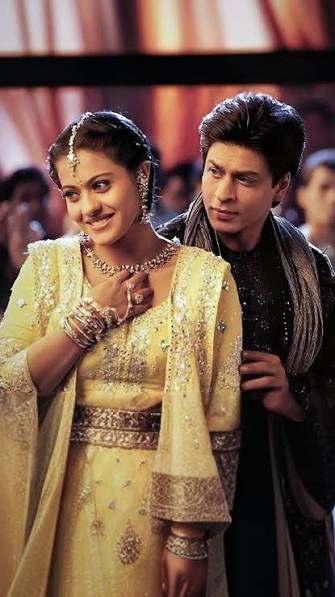
Kajol delivers one of her best performances as Anjali. Kajol earned appreciation playing romantic women in beloved Bollywood films. With “Kabhi Khushi Kabhie Gham”, however, she took on her most complex role. It is not easy to portray a lower-class woman that’s abandoned by her family but she succeeds. This is the actress unlike you have ever seen her before: intense, charming and riveting in her most memorable role. With mesmerizing expressions, she captures angst, ambitions and strong spirit of a woman seeking family affections. It’s a phenomenal performance from one of the most celebrated actresses in India today.
While the movie is mainly a bold showcase for Kajol, the supporting cast is exceptional and worthy of recognition. Shah Rukh Khan is spectacular, capturing charismatic nature of a young man that falls in love with a lower class woman against the best wishes of his father. Amitabh Bachchan is brilliant, and brings tension to a father struggling to raise a family that’s broken. Lastly, Hrithik Roshan is unforgettable. As a young son embarking on a mission, he is unforgettable.
Finally, “Kabhi Khushi Kabhie Gham” earns the appreciation of everyone for capturing hardships faced by Indian families. Unlike most Bollywood movies, it tackles universal themes everyone would be able to relate to. The film discusses themes including family, marriage and social disparities which would resonate with everyone. Viewers don’t need to have Indian identities to appreciate the movie. It delivers a powerful message about the sheer importance of family that would resonate with everyone. Therefore, “Kabhi Khushi Kabhie Gham” is one of those rare iconic Bollywood movies which everyone would adore.
Fans of Kajol would definitely enjoy “Kabhi Khushi Kabhie Gham” and so will audiences seeking meaningful entertainment. A bold Bollywood classic, it celebrates an actress that’s iconic.
Nearly 30 years following the release of a groundbreaking film about Indian families feeling a mixture of emotions torn apart by devastating social class disparities that are heartbreaking, it’s a breathtaking reminder of a commemorated actress that has built a lasting legacy in Bollywood with an enduring appeal whose engaging movies that haven’t lost their abilities to captivate audiences are definitely without a doubt worth celebrating.
5/5 stars

 The Film Buff
You must be logged in to post a comment.