
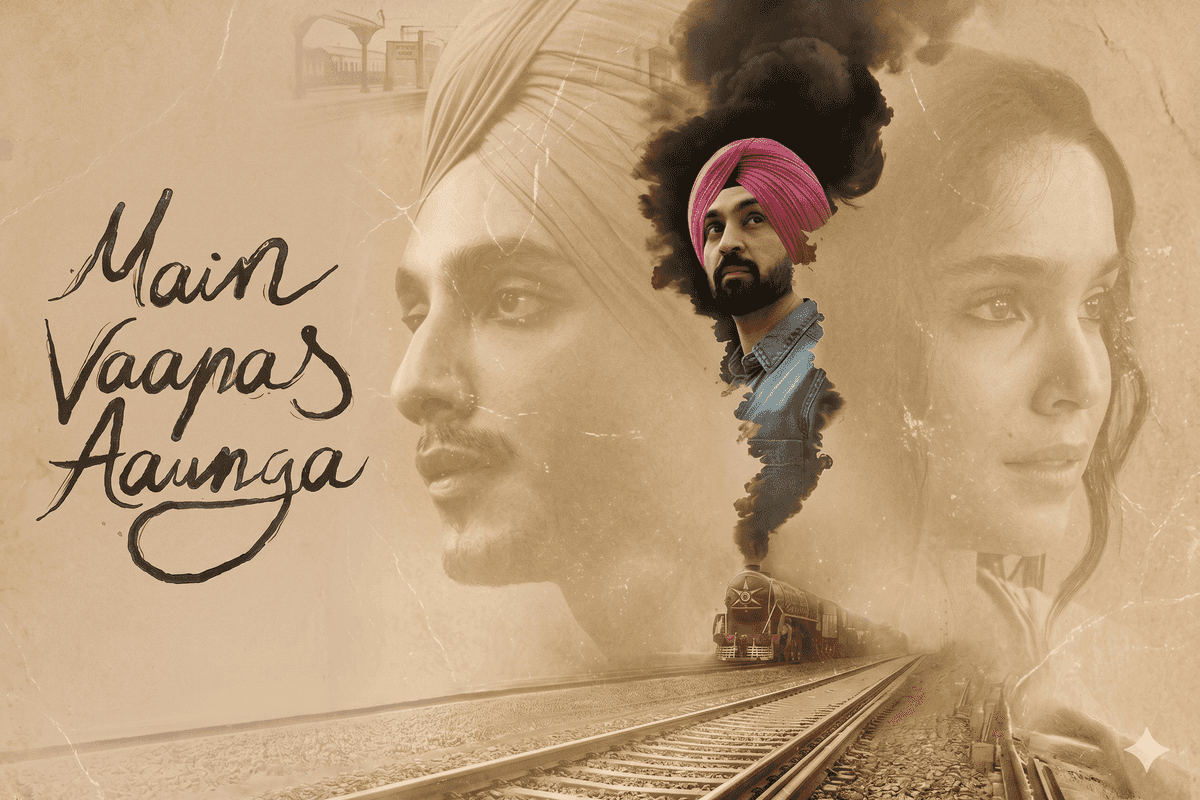
Writer/Director: Imtiaz Ali
Starring: Naseeruddin Shah, Diljit Dosanjh and Rajat Kapoor
‘A Powerful Period Piece’
Not many actors in India are as beloved as Naseeruddin Shah. Ever since his stardom during the 1980’s, Shah has become a true Indian icon. Whether it’s army officers, bold businessmen or doomed lovers, Shah has portrayed many bold characters. Arguably, Shah’s greatest strength as an actor is his strong screen presence. He is one of those actors that has talent for elevating movies through his powerful presence. Even when he isn’t the main focus of a movie, Shah has always left a strong impression. An icon in India, Shah has left behind a commendable legacy in cinema. Throughout a legendary career, Shah has created many memorable movies that are worth talking about without a doubt.
I’m a big fan of Shah and adore all the films he has made in his career. However, “Main Vaapas Aaunga” definitely stands out as his most meaningful movie. Released in 2026, Imtiaz Ali’s movie offered a powerful portrait of the horrors of Partition. Packed with bold musical sequences, engrossing storytelling and phenomenal acting, it’s a breathtaking Bollywood period piece. At the centre of it all is a terrific performance by Naseeruddin Shah, who embodies an elderly man telling stories of surviving Partition. Although “Main Vaapas Aaunga” is a brilliant period piece, it isn’t a flawless film. It builds a melodramatic ending without a satisfying resolution. That being said, it offers engaging entertainment that would definitely without a doubt satisfy fans of Naseeruddin Shah.
“Main Vaapas Aaunga” tells the story of an elderly man that recounts sad memories of surviving the Partition in India. Naseeruddin Shah plays Ishar Singh Grewal, a wise man haunted by his sad experiences in Partition. To come to terms with past trauma, Ishar recounts harrowing memories of surviving partition to his son in India. As he reflects on his past, Ishar questions how long his love for India will last. Faced with a big dilemma, Ishar wonders whether it’s possible for him to come to terms with his tragic experience in India.
Imtiaz Ali is fascinated with the themes of trauma. A brilliant Bollywood filmmaker, Ali has often made engaging movies about the lives of Indian lovers which face disaster. His iconic movie “Jab We Met” offered a strong portrait of lovers that get separated by the barriers of social class after they have met. With “Main Vaapas Aaunga”, however, the filmmaker made his first ever period piece about Partition. It was the filmmaker’s first attempt to capture the lives of individuals surviving partition tragedy but he pulled it off effectively. Using bold cinematography, Ali captures an elderly man reflecting upon surviving partition tragedy. Evoking Deepa Mehta’s “Earth”, Ali expertly uses montages to capture the lives of individuals affected by their nation’s painful birth. For instance, montages elevate the warfare scene. During this unforgettable scene, Ishar reflects on his memories of surviving warfare tragedies. Using spellbinding montages, Ali creates a portrait of Partition that’s ending. Through stunning visuals, Ali captures tensions that individuals surviving the war of Partition are experiencing.
Another admirable aspect of “Main Vaapas Aunga” which deserves appreciation is the production. From a technical perspective, it’s one of the best Bollywood period pieces you will ever see. Emulating Yash Chopra’s “Veer-Zaara”, Ali effectively employs cross-cutting to stage musical sequences about Partition which are engaging. For instance, cross-cutting elevates the Teere Pass Mein song. During this unforgettable song, Ishar recounts fond memories of his love affair in the time of warfare. Through cross-cutting, Ali constructs a portrait of warfare which is engaging. Furthermore, the musical score is superb. A.R. Rahman’s music contributes to the success of the movie. It gives the movie a haunting atmosphere capturing realities of warfare. Using phenomenal production, Ali captures the harrowing realities posed by Partition.
Storytelling is one of the main reasons why “Main Vaapas Aaunga” is a Bollywood film about partition that’s engaging. The movie is extremely well-written, and expertly uses flashbacks to capture the harsh realities of surviving Partition. The film deftly switches back and forth between two timelines: past flashbacks of Ishar’s life in Partition and the present-day scenes of his life as an elderly citizen. For instance, flashbacks elevate the warfare reflection scene. During this intense scene, Ishar recounts harrowing memories of being separated from his parents by the tragedies of Partition. Through flashbacks, Ali creates a portrait of Partition audiences relate to. Flashbacks are tricky techniques to use in Bollywood movies. As Farah Khan’s “Main Hoon Na” proved, flashbacks elevate Bollywood films about army generals. That being said, it works immensely in this movie. Through a strong screenplay, Ali captures warfare that comes with a painful price to pay.
One appreciates amazing performances.

Naseeruddin Shah delivers one of his best performances as Ishar. Shah first achieved appreciation for playing romantic heroes in Bollywood films. With “Main Vaapas Aunga”, however, he took on his most serious role. It isn’t easy to play an elderly man surviving Partition tragedies but he succeeded. This is the actor unlike you have ever seen him in the past before: intense, charismatic and emotional in his most compelling role. With riveting expressions, he captures the angst, bravery and resentments of an Indian man surviving warfare destruction. It’s a strong performance from one of the most beloved actors in India today.
While the movie is mainly a bold showcase for Naseeruddin Shah, the supporting cast is also fantastic. Diljit Dosanjh is dazzling, capturing the curious nature of an Indian man eager to learn about the Partition from his father. Rajat Kapoor is riveting, bringing gravitas to an uncle haunted by memories losing his family in warfare tragedy. Lastly, Sharvari merits appreciation. As Ishar’s love interest, she brings romantic tension to the movie.
Despite its strong performances, however, “Main Vaapas Aaunga” can’t quite capture the harrowing reality of Partition in India. If there is a minor shortcoming to the movie, it lacks an engaging ending. It’s an over-the-top conclusion that fails to bring the movie to a satisfying resolution. At worst, it sends messages about Partition that aren’t true to history. Whereas this melodramatic ending elevated Chandra Dwivedi’s “Pinjar”, it does not suit this movie. Therefore, “Main Vaapas Aaunga” is one of those Bollywood movies not everyone will adore.
Nevertheless, fans of Naseeruddin Shah will definitely enjoy “Main Vaapas Aaunga” and so will audiences seeking entertainment. A breathtaking Bollywood historical drama, it honours an actor that’s beloved in India.
A powerful portrait of Partition that affected the lives of Indian men facing tension, it’s an astonishing reminder of a beloved actor that has built a formidable reputation through his abilities to portray compelling characters in unforgettable movies throughout his career that are absolutely without a doubt worthy of appreciation.
4.5/5 stars

 The Film Buff