
Writer/Director: Clint Bentley
Starring: Joel Edgerton, Felicity Jones and William H. Macy
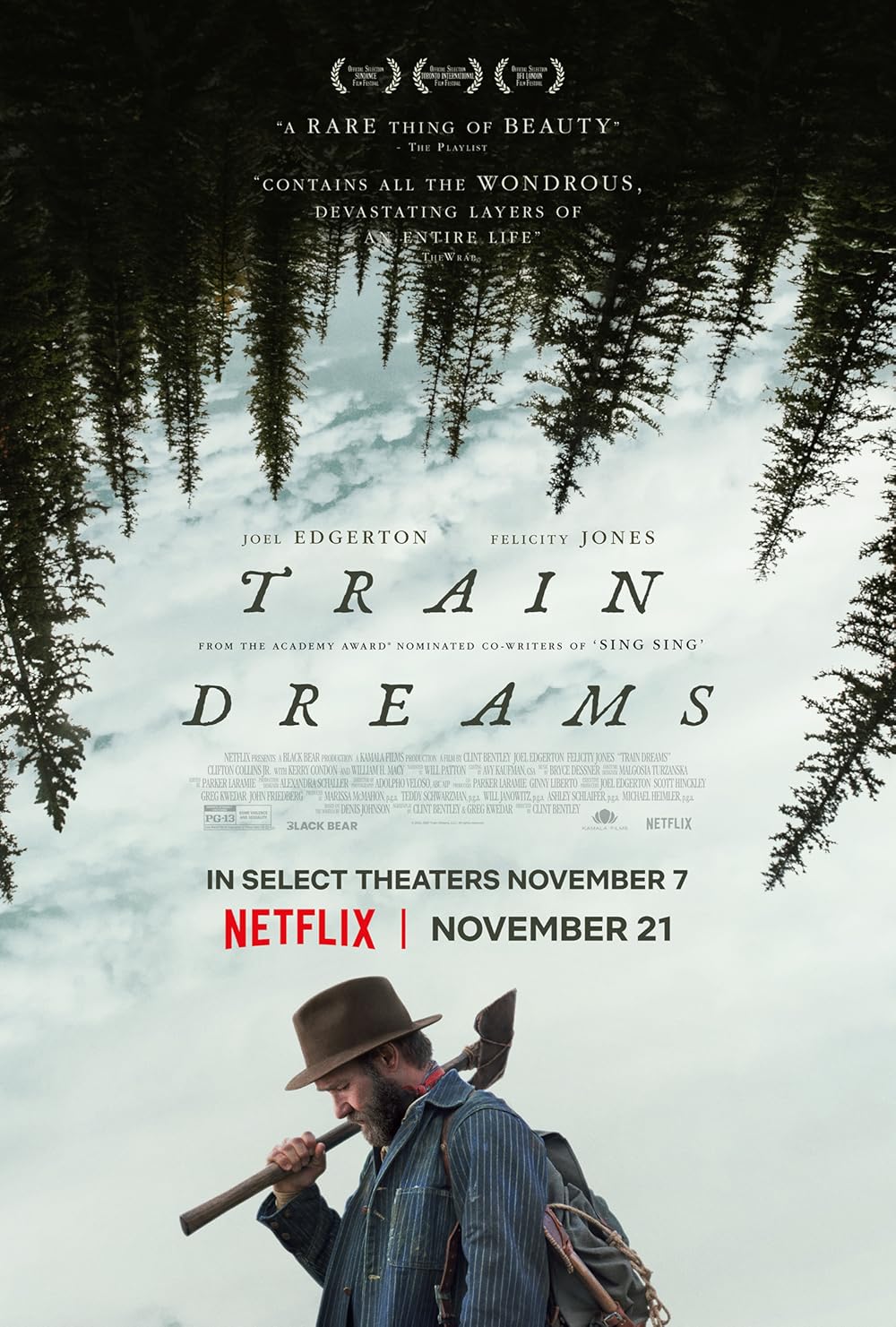
‘A Powerful Period Piece’
When it comes to the greatest books ever written about lonely men with dreams, it’s worth discussing Train Dreams. Following its publication in 2011, Denis Johnson’s book has become a literary classic. On a personal level, I find the novel about survival relatable. I remember forming bonds with a housekeeper appreciating nature. He smiled telling stories about his journeys into the wild leaving my family beguiled. Considering forests a sacred place, he would embrace nature in which he would leave no trace. He would marvel at the way forests functioned which left him cast away. Unlike ordinary people, he was a servant my family considered special. Being a philosophical person, he formed a strong connection with nature giving his life direction. Despite facing barriers of poverty, he sought to embark upon an immigration journey. Viewing America as the land of opportunity, he planned to migrate to the country. Fascinated with American railroad workers in the 20th Century, he admired the country deeply. Although my grandparents felt that his dream was an impossible mission, he sought to achieve immigration. However, Cancer brought his dreams to a tragic closure. Falling ill prevented him from achieving goals he sought to fulfill. Advised by doctors to stay at home, he abandoned forests where he loved to roam. As he became depressed, he lost interest in forests he once cherished. No matter how hard he would try, he couldn’t overcome illness causing him to die. I couldn’t help grieve loss of a labourer that never accomplished dreams he wanted to achieve. Haunted by my housekeeper’s spirit, forests became places I wouldn’t visit. No longer a positive force, nature became a source of remorse. The wilderness became a heartbreaking symbol representing my relationship with a housekeeper with illness. Years later, I cherish literature that’s a reminder about my housekeeper.
As someone treasuring a housekeeper that never accomplished dreams, I appreciated “Train Dreams”. Released in 2025, Clint Bentley’s movie honoured beloved books. Packed with breathtaking visuals, captivating storytelling and phenomenal acting, it’s an extraordinary period piece. At the centre of it is an incredible performance by Joel Edgerton, who embodies a labourer. Although “Train Dreams” is mesmerizing, it isn’t a flawless film. Its slow pace tests viewers’ patience. Nevertheless, it offers engaging entertainment for fans of period dramas.
Set during the 20th Century, “Train Dreams” follows hard-working railroad workers with dreams. Joel Edgerton embodies Robert Grainier, a philosophical railroad worker appreciating nature. Grainier acknowledges the Pacific Northwest forest where he resides with family. However, Grainier’s life changes when family is murdered in frightening forest disaster. As several years go by, Grainier’s appreciation for nature begins to die. Experiencing adversity, Grainier questions whether it’s truly possible to turn his dreams into reality.
Clint Bentley has always been fascinated with nature. His directorial debut “Jockey” offered powerful portraits of horse riders overcoming adversity. With “Train Dreams”, however, Bentley created his first literary adaptation. It’s the filmmaker’s attempt adapting legendary books about forests facing adversity but he succeeds. Evoking Debra Granik’s “Leave No Trace”, Bentley uses natural lighting to capture the beauty of forests labourers embrace. For instance, natural lighting elevates the forest discussion scene. During this unforgettable scene, Grainier has an intimate conversation with Arn Peeples expressing his love for mother nature. It brought back fond memory of a housekeeper that appreciated wilderness shaping his identity. Natural lighting is a tricky technique. As Robert Redford’s “Ordinary People” suggested, natural lighting elevates dysfunctional family dramas. Nevertheless, it works immensely in this movie. Using stunning visuals, Bentley captures frightening hardships loggers in the wilderness are facing.
Another admirable aspect of “Train Dreams” that merits appreciation is production. The film demands to be seen on the big-screen for its depiction of forests that are green. Evoking Sean Penn’s “Into the Wild”, Bentley uses real-life forests across the United States to capture dangers of the wild. For instance, the real-life locations elevate the forest fire scene. During this heartbreaking scene, Grainer faces grief when he discovers that his family has been killed in a forest fire destruction. It reminded me about my grief when I discovered that a housekeeper I appreciated passed away from heartbreaking terminal illness leaving family devastated. Moreover, the musical score is magnificent. Bryce Dessner’s music contributes to success of the movie. It gives the movie intense atmosphere capturing painful burden forest dwellers bear. Through breathtaking production, Bentley honours commemorated books about wilderness destruction.
Storytelling is one of the reasons why “Train Dreams” is a film about nature that’s engaging. In Hollywood, most movies portray forests as frightening locations that cause inhabitants to face tensions. For instance, M. Night Shyamalan’s “The Village” portrayed forests as locations filled with creatures that threaten a village. Thankfully, however, “Train Dreams” avoids these pitfalls. Evoking Robert Zemeckis’ “Cast Away”, Bentley effectively uses symbolism to convey grief of individuals that are cast away. Throughout the movie, the forest is a strong symbol showcasing Grainier’s grief over losing his family. For instance, symbolism elevates the loss scene. During this profound scene, Grainier expresses grief losing love for mother nature following the death of his family. It reminded me of my sadness losing interest in wilderness following death of a housekeeper that passed away from illness. Symbolism is a tricky technique. As John Krasinski’s “A Quiet Place” suggested, symbols elevate horror movies about survival. Nevertheless, it works in this movie. Through a spectacular screenplay, Bentley honours a book that’s beloved today.
One appreciates astonishing performances.

Joel Edgerton delivers a career-defining performance as Robert Grainier. Edgerton earned praise for Australian crime dramas. With “Train Dreams”, however, he took on his most emotional role. It isn’t easy to embody a railroad worker during the 20th Century but he succeeds. This is the actor unlike you’ve ever seen him: intense, charismatic and emotional. Evoking Leonardo DiCaprio in Alejandro Gonzalez Innaritu’s “The Revenant”, Edgerton embodies a frontiersman in an environment. With bold expressions, he captures angst, bravery and grief of a logger facing destructions. It’s a phenomenal performance from one of the finest actors today.
While the movie is mainly a stunning showcase for Edgerton, the supporting cast is also sensational and worthy of recognition. Felicity Jones is fantastic, capturing the bravery of a woman that becomes victim of a forest fire tragedy. William H. Macy is wonderful, bringing wisdom to an elderly railroad worker fond of the forest he considers a precious ecosystem. Lastly, Kerry Condon merits appreciation. As a grieving woman, she is unforgettable.
Despite its extraordinary acting, however, “Train Dreams” can’t capture the beauty of forests about which people strongly feel. Bentley’s decision to use voice-over narration in the movie is admirable but hinders the pacing. Due to his faulty technique, scenes in which a narrator explains events aren’t as engaging as Grainier’s journey to embrace forestry. As Frank Darabont’s “The Shawshank Redemption” suggested, narration elevates classic movies about prison. At worst, the voice-over narration serves as a distraction affecting impact of a story about isolation. Ultimately, the narration feels unnecessary in a movie that’s all about embracing visual beauty. Consequently, “Train Dreams” can’t quite honour a book about labourers with dreams.
Nevertheless, fans of Joel Edgerton will definitely appreciate “Train Dreams” and so would movie-goers seeking meaningful entertainment. A mesmerizing period piece, it proves that stories of the wilderness are worth telling in movies.
Nearly 15 years following the publication of an iconic book about depressed railroad workers that face unrest in the forest, it’s a riveting reminder that stories of mother nature are absolutely worth telling in movies leaving audiences impressed.
As strong as Robert Grainer’s desire to be a railroad worker, it has inspired me to move on many years after the heartbreaking death of a housekeeper that never got to accomplish his dreams by remembering memories of a commemorated companion that motivated my passion for mother nature that I will forever treasure.
4.5/5 stars

 The Film Buff