

Writer/Director: Todd Phillips
Starring: Joaquin Phoenix, Lady Gaga and Brendan Gleeson
‘A Marvellous Sequel’
Few villains in popular culture are as admired as the Joker. Following his introduction during the 1990’s, the Joker has played a strong role in comic-book movies. An iconic figure in pop culture, the Joker has stood the test of time as a legendary character. Through capturing the hardships people suffering from mental illness face, the Joker has become a villain audiences embrace. A villain with strong style, the Joker has always left audiences with a lasting smile. Arguably, the Joker’s greatest strength as a villain is his ability to surprise. Through taking dark risks, the Joker has become a villain that audiences value. He has always been one of those rare villains with sympathetic backstory that everyone can easily relate to. A fantastic villain, the Joker has built a long-legacy which has proven to be iconic. Throughout a lasting cinematic history, the character has appeared in several movies which are definitely without any doubt worth watching. Each and every film adaptation has offered a strong interpretation of a commemorated supervillain that deserves recognition.
As a huge fan of a villain that I have grown up to value, I admired “Joker: Folie a Deux”. Todd Phillips’ comic-book blockbuster provides an interesting take on an iconic villain through a perspective of mental health. Despite negative reviews from critics, the film isn’t as bad as it has been made out by the general public to be. Packed with bold visuals, engaging storytelling and powerful performances, it’s a sensational comic-book movie. At the centre of it all is an incredible performance by Joaquin Phoenix, who captures a maniacal personality of the supervillain. Although “Joker: Folie a Deux” is a captivating comic book film, it isnt flawless. It’s poorly paced, and lacks compelling character development of its superior predecessor. Nevertheless, it offers exhilarating entertainment which fans of the commemorated villain won’t be able to resist.
Following the events of “Joker”, “Joker: Folie a Deux” follows the journey of a villain seeking to make his dreams come true. Joaquin Phoenix portrays Arthur Fleck, the mentally disturbed criminal with a love for telling jokes. Following his murder on live television, Arthur has been confined in Arkham Asylum. Considered to be a serious threat to society, Arthur is prevented from finding identity. At first, all hope seems to be lost for Arthur who has forgotten what it is like to be the Joker. However, Arthur’s painful life forever changes when he finds love amidst disaster. Falling in love with Lee Quinzel (Lady Gaga), Arthur is given a chance to escape his dilemma. Arthur enjoys spending time with Lee who gives him hope to cope with catastrophes. As he faces the pressures of Arkham Asylum, Arthur questions whether he will ever become a villain again achieving stardom. Seeking to escape mental institutions which pose danger, Arthur endeavours to once again become the Joker.
Todd Phillips is fascinated with stories about the Joker. A massive comic-book fan, Phillips has always been drawn toward the renowned villainous character. Before he directed “Joker: Folie a Deux”, Phillips had already made films about the comic-book character. His previous movie “Joker” introduced the iconic villain to a modern generation. With “Joker: Folie a Deux”, however, Phillips created his first sequel. It was the filmmaker’s first attempt to reimagine the renowned comic-book character facing mental health barriers but he succeeded immensely. Through spellbinding cinematography, Phillips captures a villain embarking upon a journey to discover identity. Visually, the film is a stunning feast. Phillips effectively uses low-key lighting to capture the gloomy atmosphere of a mental institution where Arthur Fleck is confined. Low key lighting plays a pivotal role throughout the movie in capturing the downtrodden nature of an institution that’s terrifying. For instance, the low-key lighting enhances the opening scene. During this unforgettable scene, Arthur follows the mundane routine of cleaning clothes in an institution. Through low-key lighting, Phillips captures grim hardship people with illness go through. Low-key lighting is a tricky technique to use in movies. As David Fincher’s “Se7en” suggested, low-key lighting enhances serial killer movies. Nevertheless, it works immensely in this movie. Through breathtaking visuals, Phillips captures a mental institution which is terrifying.
Another commendable aspect of “Joker: Folie a Deux” worth praising is the production. From a technical perspective, the movie is extremely well made. Phillips’ choice to integrate musical sequences into the film is risky but it succeeds extremely. Phillips effectively uses live singing to stage memorable musical sequences which capture lovers bonding. For instance, the live singing elevates the “That’s Life” music scene. During this unforgettable scene, Arthur forms a powerful bond with Lee singing and dancing together in a mental institution. One admires live singing bringing to life the bonds between lovers which are engrossing. Live-singing is a tricky technique to employ in movies. As Tom Hooper’s “Les Miserables” suggested clearly, live singing elevates adaptations of Broadway musicals. Nevertheless, it works immensely in this movie. Furthermore, the musical score is memorable. Hildur Guonadottir’s music is key to the movie’s success. It gives the film a tense atmosphere capturing the heavy burden which commemorated comic-book villains bear. Through phenomenal production, Phillips celebrates the legacy of an iconic supervillain.
Amidst the thrilling musical sequences, “Joker Folie a Deux” finds time to tell a strong story. The film is beautifully written, and effectively uses unreliable narration to capture tensions endured by a supervillain with mental illness. Phillips’ greatest screenwriting strength is his ability to capture the lives of supervillains that suffer from mental illness through the uses of unreliable narration. Throughout the film, the Joker is an unreliable narrator which struggles telling the difference between the reality and his fantastical imagination. For instance, the unreliable narration elevates the scene where Arthur has a fantastical dream of escaping his mental institution. Unreliable narration isn’t an easy technique to use in films. As Christopher Nolan’s “Inception” demonstrated, unreliable narration elevates science fiction films about fantastical dreams. Martin Scorsese’s “Shutter Island” claimed unreliable narration enhances adaptations. Nevertheless, it works extremely in this movie. Through an engaging screenplay, Phillips celebrates a legacy of a commentated villain today.
One appreciates astonishing performances.
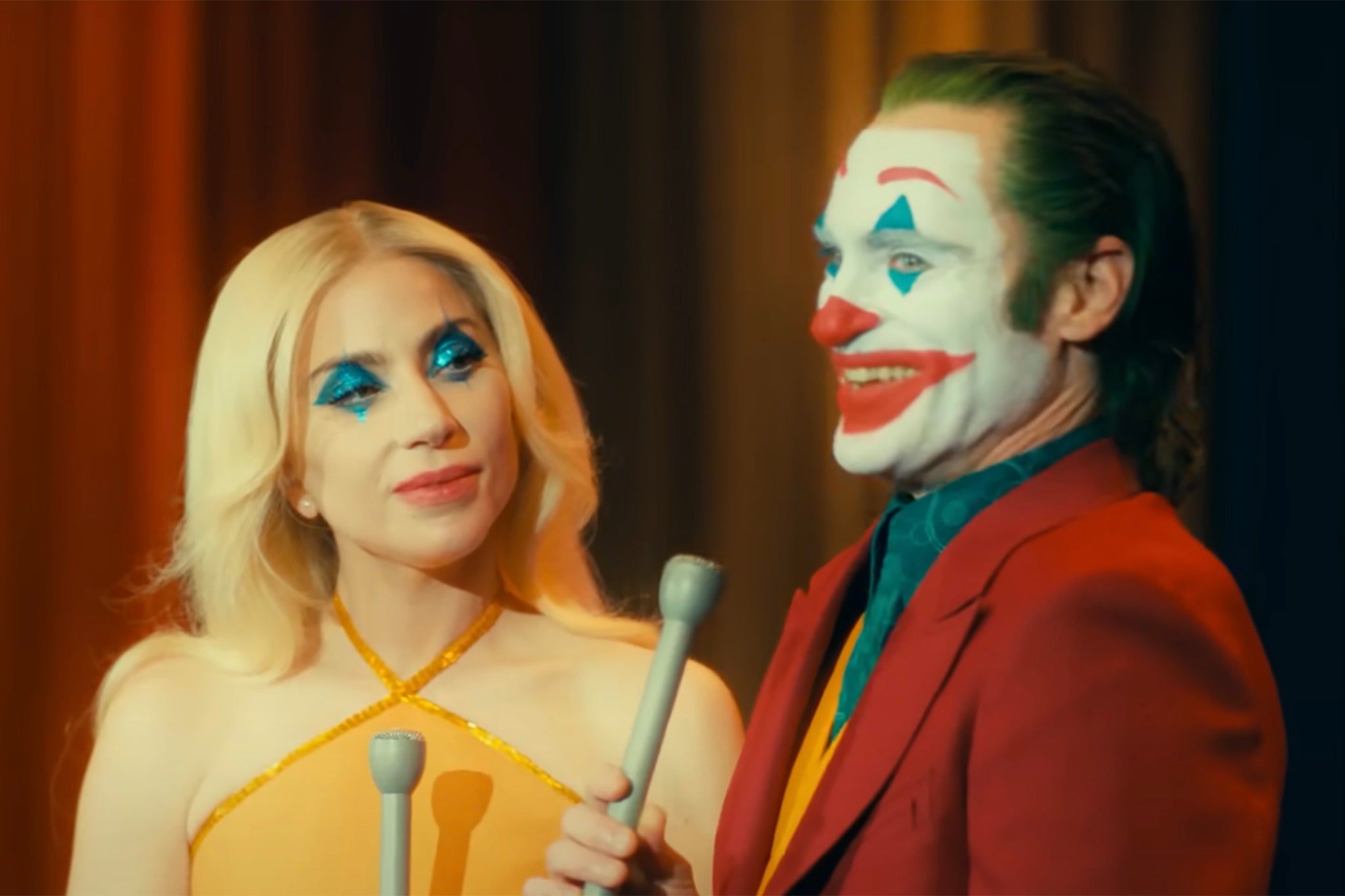
Joaquin Phoenix delivers one of his greatest performances as the Joker. Phoenix achieved appreciation for playing the iconic supervillain facing danger in “Joker”. With “Joker: Folie a Deux”, however, he took on his most psychotic role. It isn’t easy to embody an iconic villain in comic-book history but Phoenix succeeded. This is the actor unlike you have ever seen him before: intense, charismatic and emotional in his most transformative role. Phoenix has often excelled at portraying characters through the approach of method acting, and “Joker: Folie a Deux” showcased his strengths. With riveting expressions, he captures the angst, frustration and resentment of a comic-book villain which is trapped in a mental institution. It’s a terrific performance from one of the greatest actors working in Hollywood today.
Lady Gaga is spectacular as a woman facing a dilemma when she falls in love with a psychotic villain enduring trauma. While Phoenix gets the showier role, Gaga is also excellent as a strong woman whose life lacks a clear goal. As Harley Quinn, Gaga does an excellent job of portraying a strong female comic-book character. Gaga has always had an aptitude for singing as an iconic musician, and “Joker Folie a Deux” showcased her strength as a singer. Whether she’s joyfully flirting with Arthur or yearning to escape from grim mental institutions, Gaga effectively uses her powerful voice to depict a powerful comic-book character. It’s a powerful performance by one of the most commemorated musicians working in Hollywood today.
Finally, “Joker: Folie a Deux” would achieve the praise of everyone for capturing hardships that mentally ill individuals go through. Unlike most comic-book movies, the film tackles universal themes that everyone would relate to. The film tackles strong themes such as identity, mental health and incarceration which would definitely resonate with everyone. Viewers don’t need to be familiar with the comic books to appreciate it. It delivers a universal message about mental health which would resonate with everyone.
Despite its universal themes, however, “Joker: Folie a Deux” can’t entirely celebrate a villain audiences value. If there’s a shortcoming to the movie, it lacks engaging pacing. Phillips’ decision to integrate subplots about courtrooms into the movie is bold but doesn’t entirely succeed. A large part of the film takes place in a courtroom where the Joker is interrogated for his crimes. Unfortunately, these scenes don’t feel necessary in the movie. Whereas these courtroom scenes elevated Rob Reiner’s “A Few Good Men”, they clash with the realism of this movie. Moreover, the film lacks a compelling ending. The movie ends on an ambiguous note without a satisfying resolution. It’s an abrupt conclusion that lacks a strong resolution. At worst, it seems intended merely for the sole sake of setting up a sequel. In this regard, “Joker: Folie a Deux” can’t quite live up to the high standard of its predecessor. Therefore, “Joker: Folie a Deux” falls short.
Nevertheless, fans of the Joker will definitely enjoy “Joker: Folie a Deux” and so will movie-goers seeking exhilarating entertainment. A fantastic comic-book masterpiece, it celebrates the legacy of a villain that’s iconic.
Nearly 90 years following the creation of a frightening supervillain leaving a permanent smile on the faces of audiences building a legacy that’s long-lasting, it’s a riveting reminder about a legendary comic-book character with a maniacal laugh that has earned a huge fan following gaining global recognition for his abilities tell commemorated stories about scars that are compelling whose timeless tales are definitely worth celebrating
3.5/5 stars

 The Film Buff