
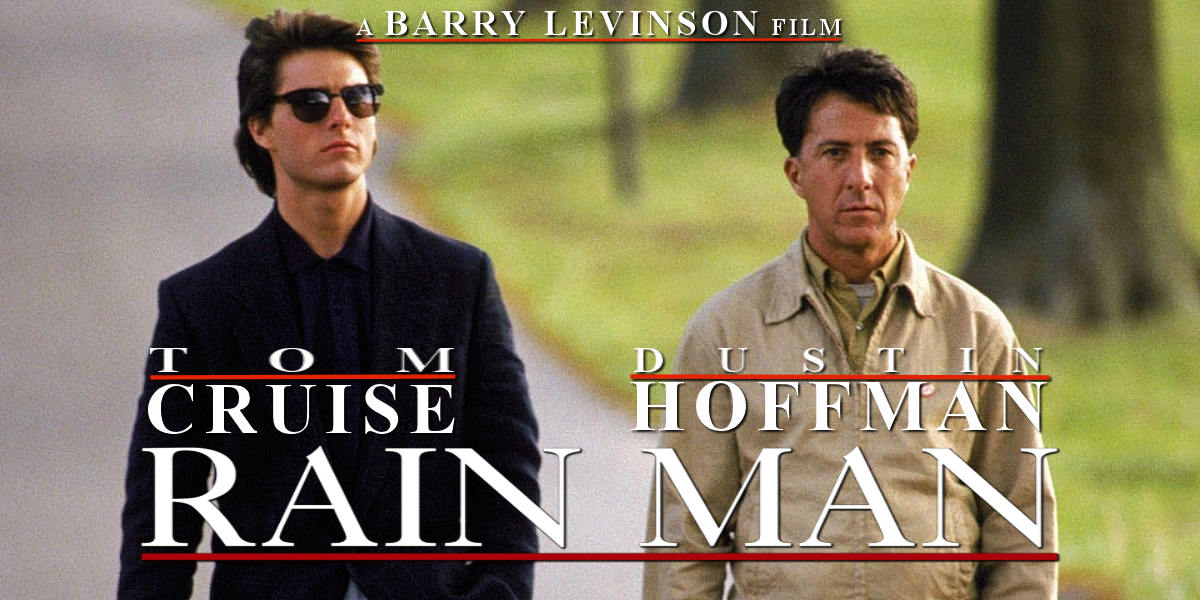
Director: Barry Levinson
Starring: Tom Cruise, Dustin Hoffman and Valeria Golino
‘A Timeless Classic’
Autism is a sensitive subject rarely depicted in movies with respect. Hollywood has struggled to tell realistic stories about individuals with disabilities. It’s always been hard for Hollywood to make an effective movie about a mental health condition that’s commonly misunderstood. Most movies about Autistic individuals are characterized by stereotypes rarely true to reality. Movies often depict Autistic individuals as victims destined to face catastrophe. It’s safe to say that the disease has been portrayed in an exaggerated way in movies today. As someone that suffers from the intellectual disability, I’ve found movies have rarely portrayed it accurately. For these reasons, it’s rare to see realistic depictions of Autism in movies.
I’ve seen several movies that have failed to accurately depict the mental condition, but “Rain Main” is an exception. Released in 1988, Barry Levinson’s Oscar-winning film painted a powerful portrait of a disease leading lives of individuals to deteriorate. It was the first ever mainstream movie to shine light on a complicated intellectual disability that wasn’t fully understood back in the 1980’s. Boasting exquisite cinematography, sharp storytelling and phenomenal performances, it’s one of the best movies ever made about a mental condition. At the centre of it all are two extraordinary performances from Tom Cruise and Dustin Hoffman, capturing bonds between brothers impacted by a disorder. Ultimately, it delivers a powerful message that resonates with everyone that has shared strong relationships with siblings at an early age.
Set in 1980’s Los Angeles, “Rain Main” tells the story about bonds between two brothers impacted by an intellectual disability. Tom Cruise embodies Charlie Babbitt, a selfish car dealer that seeks success in the automobile industry. However, Charlie’s life forever changes when he is shocked to discover that he has an estranged Autistic brother Raymond (Dustin Hoffman). Forced to become a legal guardian, Charlie expresses frustration dealing with a brother that suffers from a misunderstood mental condition. As Charlie develops a strong bond with Raymond, he gains a greater understanding of an intellectual disability.
Barry Levinson is a newcomer to disabilities. Prior to directing “Rain Man”, Levinson was known for his political movies about Vietnam War broadcasters. With “Rain Man”, however, Levinson crafted his first movie about intellectual disabilities. It was the filmmaker’s first attempt to capture the adversities faced by individuals with Autism, but he succeeded. Through captivating cinematography, Levinson captures an Autistic savant embarking on a road trip journey. Levinson expertly uses point-of-view shots to capture the world from the perspective of a person with Autism. The point of view of a person with Aspergers differs significantly from that of a person without disabilities. This difference is beautifully conveyed through the point-of-view shots. For instance, the shots of Charlie’s worldview are clear without any mental disorientation. On the other hand, shots from Raymond’s perspective are often disoriented showcasing his mental condition. Through these point-of-view shots, Levinson captures hardships autistic savants go through. Using spellbinding cinematography, Levinson celebrates lives of individuals with intellectual disabilities.
Another admirable aspect of “Rain Man” that contributes to its success is the sound-design. For a film made in the 1980’s, “Rain Main” has aged incredibly well over time. Levinson expertly uses sound-design to capture plight of autistic individuals facing a mental decline. Whether it’s sound of alarm bells ringing or tv shows airing, Levinson cleverly uses diegetic sounds to capture an Autistic person that’s sensitive to hearing. For instance, sound-design elevates the alarm bell sequence. During this heartbreaking scene, Raymond experiences a frightening panic attack when he hears deafening sounds of fire alarms ringing. One appreciates diegetic sounds capturing the adversities of individuals with intellectual disabilities. Through this ingenious sound design, Levinson paints an authentic portrait of adversities that Autistic savants go through. Using phenomenal production, Levinson captures harsh realities of a misunderstood mental condition.
Storytelling is key to the success of “Rain Man”. The film is beautifully written, and captures bonds between individuals with a mental condition. Barry Morrow’s screenwriting strength is capturing strong bonds between brothers affected by mental illness through minimal dialogue. In Hollywood, most movies about Autism depict stereotypes. Movies about Autistic individuals often portray them as tragic victims of a mental condition that’s catastrophic. Fortunately, however, “Rain Man” avoids these pitfalls. Morrow expertly uses sequences of silence to capture bonds between brothers on a road trip. Throughout the film, silence is used to capture bonds Charlie shares with his brother Raymond. For instance, silence elevates the scene where Charlie has pancakes with Raymond at a restaurant. Through this clever technique, Morrow creates a compelling Autistic character viewers relate to. Using a sharp screenplay, Levinson captures a misunderstood disability today.
One appreciates astonishing performances. “Rain Main” simply wouldn’t be the awe-inspiring classic that it is without the phenomenal acting.
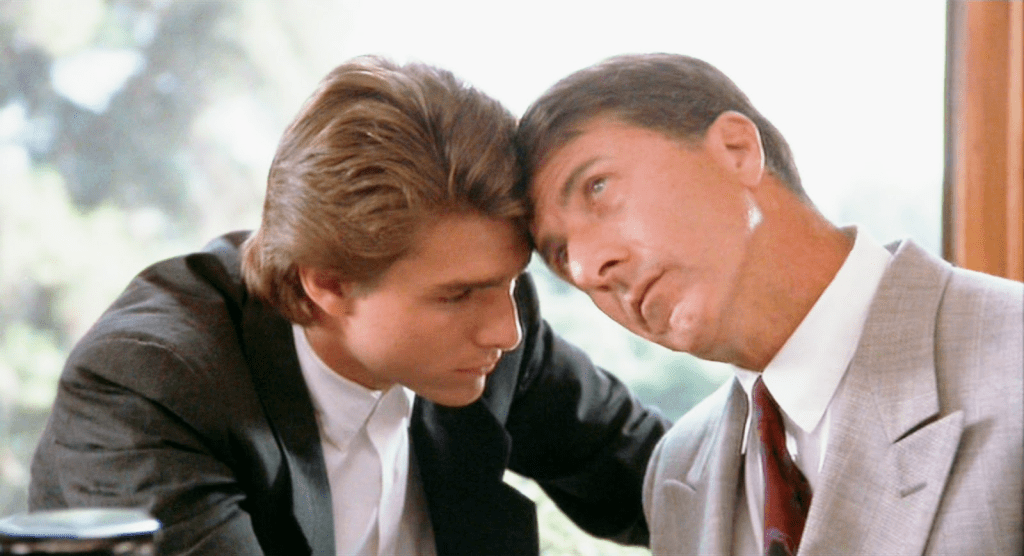
Tom Cruise delivers one of the best performances of his career as Charlie Babbitt. Cruise achieved appreciation in his career for playing action heroes accomplishing impossible missions. With “Rain Main”, however, Cruise took on his first dramatic role. It’s challenging to embody the personality of a car dealer tasked with taking care of his Autistic brother, but Cruise succeeds. With mesmerizing expressions, he captures the angst, frustration and resentment of a man tasked with taking care of an Autistic savant. It’s a phenomenal performance that launched the prosperous career of one of the world’s most celebrated movie-stars today.
Dustin Hoffman is dazzling as a charismatic Autistic savant diagnosed with a mental condition that’s tragic. In an Oscar-winning role, Hoffman poured his heart and soul into an Autistic man facing a painful emotional toll. Hoffman expertly uses subtle body language to capture an Autistic savant’s strong bond with his brother. Whether he’s joyfully playing poker with Raymond or gesturing goodbyes at train stations, Hoffman brilliantly uses subtle body gestures to capture Raymond’s unbreakable bond with his brother. It’s a phenomenal performance that offers an accurate portrait of an intellectual disability affecting people today.
Finally, “Rain Man” is one of those rare movies that would entertain everyone through depiction of a disease causing pain. Unlike most movies about Autism, it’s a film everyone would relate to. It tackles universal themes such as brotherhood, family and mental health. Viewers aren’t required to suffer from an intellectual disability to appreciate the movie. It delivers a universal message resonating with everyone forming strong bonds with brothers at an early age. As an Autistic individual that has always shared a strong bond with my brother, I deeply related to Raymond’s journey. Therefore, “Rain Man” is a one-of-a-kind movie that everyone would adore.
Viewers affected by Autism will definitely appreciate “Rain Man” and so will movie-goers seeking meaningful entertainment.
Nearly 30 years following the release of an iconic film about brothers throwing a tantrum on rainy road trips that suffer from Autism, it’s a poignant reminder of a classic that forever changed the world through its groundbreaking depiction of a devastating mental problem that proved Cinema is a powerful medium which could educate people about a disability all too often treated in society with stigma as a shock to the system.
5/5 stars

 The Film Buff
You must be logged in to post a comment.