

Director: Roman Polanski
Starring: Adrien Brody, Thomas Kretschmann and Frank Finlay
‘A Haunting Masterpiece’
The Holocaust is a sensitive subject rarely depicted in movies with respect. Nearly 80 years following Hitler’s downfall, it’s proven hard to depict a genocide that’s painful to recall. Hollywood has often struggled to tell compelling stories about a grim mass genocide in history. No matter how hard they have tried, filmmakers have commonly failed to recreate a genocide in which people died. A tough subject matter, it’s hard to do justice towards a gruesome disaster. When making a movie about the Holocaust, filmmakers have to strike a fine balance between entertainment and historical accuracy. It’s a tricky balance that most movies are unable to achieve. Therefore, it’s rare to see authentic depictions of genocide on the big-screen.
Over the years, I’ve seen several movies that have failed to depict the mass genocide in history. However, “The Pianist” stands out as a melodious exception. Released in 2002, Roman Polanski’s Oscar-winning movie did an extraordinary job depicting the mass genocide in history. Drawing from his own personal experiences as a Holocaust survivor, Polanski paints a painfully accurate portrait of a mass genocide disaster. Boasting exquisite production-design, soulful storytelling and phenomenal performances, it’s one of the greatest movies ever made about the Holocaust. At the centre of it all is a phenomenal performance from Adrien Brody, who transforms into a real-life pianist that survived the Holocaust. Unlike most movies about the genocide, it’s a powerful film with themes everyone would relate to. A haunting masterpiece, it proves Cinema is a powerful art-form that can educate people about a genocide that’s frightening.
Set in Warsaw, “The Pianist” tells the true story of a Jewish pianist that miraculously survived a mass genocide tragedy. Adrien Brody embodies Wladyslaw Szpilman, a Jewish pianist that makes a living by playing melodies in a war-torn country. Szpilman has big dreams of becoming a successful pianist. However, Szpilman’s dreams are destroyed when his family becomes the victim of a gruesome mass genocide disaster. Forced to move into a Warsaw ghetto, Szpilman abandons passion for music that he once pursued with energy years ago. After being separated from his family, Szpilman makes it life mission to survive a grim catastrophe. Unable to hide, Szpilman is forced to confront harsh realities of a gruesome genocide.
Roman Polanski is fascinated with the Holocaust. A Jewish filmmaker, Polanski’s family has long-time ties to the mass genocide disaster. At an early age, the filmmaker was separated from his family in a mass genocide causing emotional damage. The mass genocide disaster left a lasting impression on the filmmaker. “The Pianist” was Polanski’s first film where he drew from his personal experiences to create a portrait of the Holocaust. It was the filmmaker’s first attempt to capture a mass genocide disaster in history, but he succeeded tremendously. Through captivating cinematography, Polanski captures a mass genocide from the perspective of a Jewish pianist. Visually, the film is a feast for the eyes as stunning as melodies that pianists organize. Polanski expertly uses point-of-view shots to capture the mass genocide occurring through eyes of a Jewish pianist. Whether it’s Szpilman’s glances at warfare through a window or sight of Jews being killed in the ghetto, Polanski uses point-of-view shots to capture perspective of a pianist that faced genocide years ago. Through point-of-view shots, Polanski captures hardships that Jewish musicians in WWII went through. Using breathtaking visuals, Polanski captures a genocide that’s frightening.
Another admirable aspect of “The Pianist” deserving appreciation is the sound-design. From a technical perspective, the film is extremely well-made and uses sounds to capture impact of a genocide that’s destructive. Polanski effectively uses diegetic sounds to capture consequences of a mass genocide that’s tragic. For instance, diegetic sounds elevate the building explosion scene. During this frightening scene, Szpilman faces a nerve-wracking situation of trying to stay alive in a building that’s attacked by soldiers gun firing. One admires diegetic sounds capturing the nerve-wracking genocide. From the deafening sound of gunfire to bombs exploding, the diegetic sounds immerse viewers into the war setting. Through these immersive sounds, Polanski manages to capture hardships that Polish Jews went through. Moreover, the music is magnificent. Wojciech Kilar’s music is intense, emotional and heartbreaking. It celebrates beautiful melodies of a Jewish pianist. Through awe-inspiring sound-design, Polanski captures a war causing lives to decline.
Storytelling is one of the main reasons why “The Pianist” is a classic Holocaust film that remains compelling. The film is beautifully written, and uses silence to capture a Jewish pianist’s tragic experience. Polanski’s screenwriting strength is using silence to capture a Holocaust survivor haunted by a past of violence. In Hollywood, most movies portray Jews as victims of the Holocaust. Thankfully, though, “The Pianist” avoids pitfalls. Throughout the movie, Wladyslaw Szpilman adopts a silent attitude after enduring a genocide of massive magnitude. Sequences of silence elevate the final scenes where Szpilman reflects on his traumatic experiences during the war. Through silence, Polanksi crafts a compelling character whom audiences can easily relate to. Silence is a complicated technique. Movies about the Holocaust are usually driven by deafening sounds capturing warfare. As Steven Spielberg’s “Schindler’s List” suggested, movies about the Holocaust are driven by deafening sounds rather than silence. Nevertheless, it works tremendously. Through a spectacular screenplay, Polanski captures a genocide that came with a painful price to pay.
One admires astonishing performances. The film wouldn’t be an enduring classic if it weren’t for the phenomenal acting.
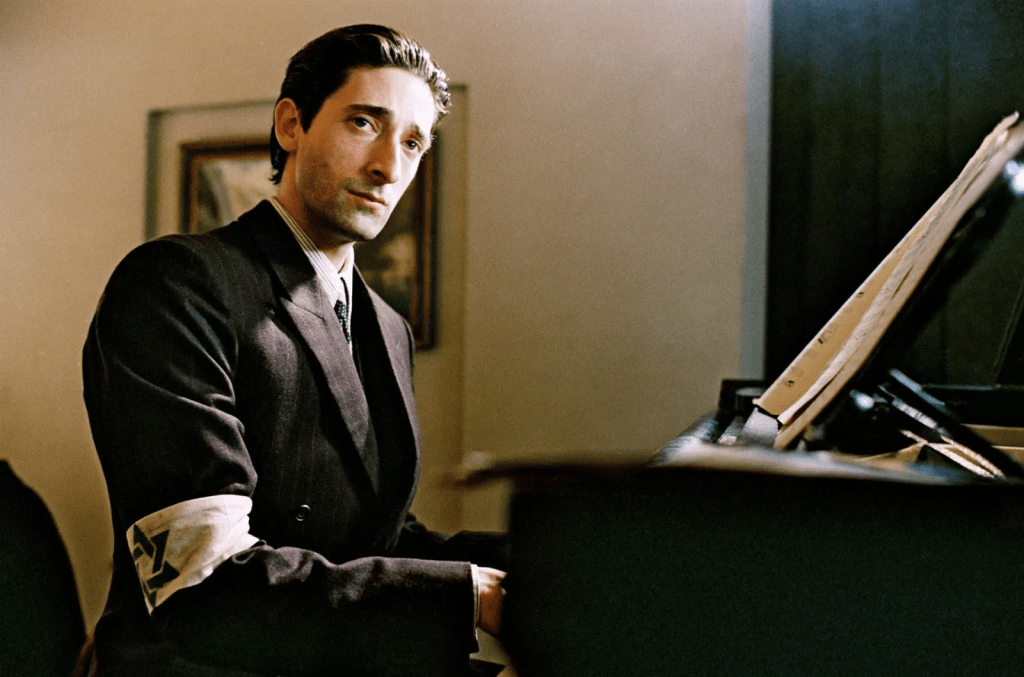
Adrien Brody delivers a career-defining performance as Wladyslaw Szpilman. Before making “The Pianist”, Brody was not a well-known actor in the film industry. At the time, Brody had never made a major Hollywood movie. It isn’t easy to embody the personality of a Jewish pianist that miraculously managed to survive WWII, but he succeeded. In an Oscar-winning role, Brody poured his heart and soul into a musician facing an emotional toll. Not only did Brody lose weight for the part, but he captures the emotion of a musician whose life was torn apart. With mesmerizing expressions, he captured angst, determination and perseverance of a real-life musician. It’s a phenomenal performance celebrating a real-life Holocaust survivor.
While the film is mainly a stunning showcase for Brody, the supporting cast is also worthy of recognition. Thomas Kretschmann is terrific, capturing the bravery of a German solider that put his life in danger to rescue Jews from a frightening mass genocide tragedy. Frank Finlay is fantastic, bringing humanity to a father that is determined to keep his family out of harm’s way in a genocide with a painful price to pay. Lastly, Maureen Lipman deserves appreciation. As Szpilman’s mother, she brings heartfelt emotion to the movie.
Finally, everyone will appreciate the melodies composed in “The Pianist” capturing mass genocides in history. Unlike most films about the Holocaust, it’s a movie everyone would be able to relate to. It tackles universal themes including identity, genocide and trauma. Viewers aren’t required to be knowledgeable about history to appreciate it. Despite capturing a mass genocide that took place several years ago, the film’s themes remain relevant. It delivers a powerful message which would resonate with everyone that has faced trauma at an early age. Therefore, “The Pianist” is one of those rare movies about the Holocaust everyone would adore.
Fans of historical dramas will definitely appreciate “The Pianist” and so will movie-goers interested in learning about Holocaust history. A breathtaking biopic, it celebrates a heroic Jewish musician that miraculously survived a genocide that was catastrophic.
Nearly 90 years after a Jewish musician that was fond of playing the piano miraculously managed to survive a Warsaw ghetto, it’s a powerful tribute towards a real-life survivor of the Holocaust that managed to overcome sorrow through strong will to survive whose inspirational story that deserves to be depicted in movies could contribute to understanding of a genocide that caused lives of the Jewish population to hit a crushing low.
5/5 stars

 The Film Buff
You must be logged in to post a comment.