
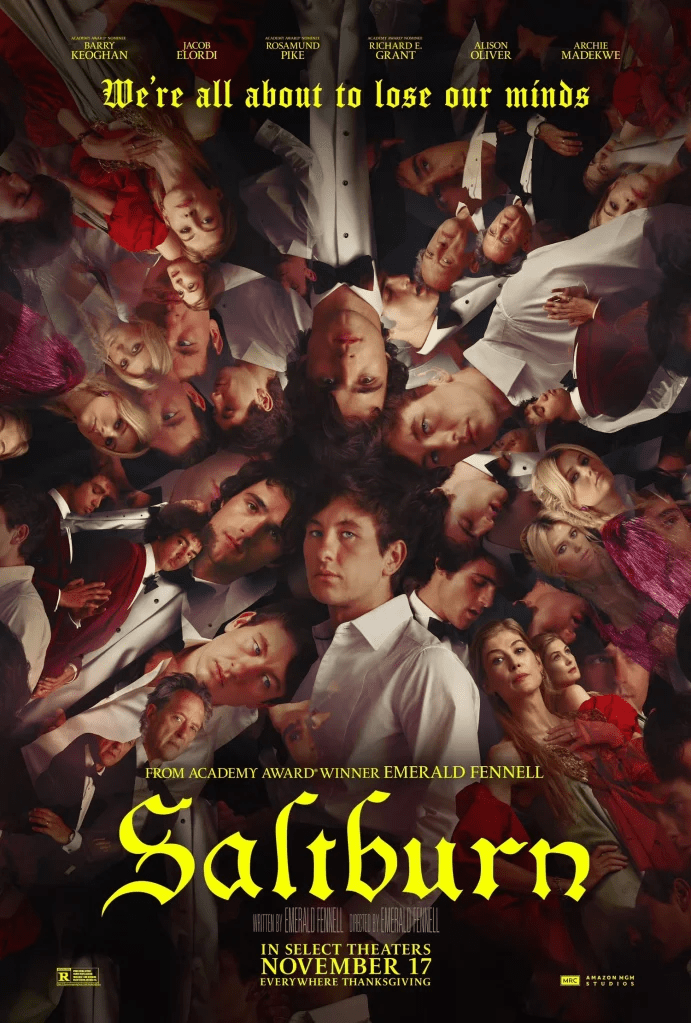
Writer/Director: Emerald Fennell
Starring: Barry Keoghan, Jacob Elrodi, Rosamund Pike
‘Sensational Satire’
Few countries promote class tension like Great Britain. The U.K. has created great barriers that impact social classes today. In a nation where inequality exists without doubt, housekeepers taking knives out scarcely achieve dreams they are passionate about. Parasite class struggles are hidden in plain sight. On a personal level, I find Britain’s class struggles relatable. From an early age, I bonded with a classmate holding privilege. I fondly recall with nostalgia forming friends with a rich kid in Saudi Arabia. Hailing from the royal family, he lived lifestyles of luxury. Given wealth his family would acquire, he was a student my school came to admire. As wealthy as Gatsby, he would boast about family’s prosperity. He told stories of his household that was a sight to behold. Despite our differences in social standing, we developed a relationship that was long-lasting. I became fond of a classmate I loved to call by his name. He treated me with pride in countries with prejudiced class divide. I looked forward to spending the remains of the day with a classmate impacting life in a big way. I found it easy to get along with a classmate from an upper-class background. I always gaped in astonishment at homes of an affluent student. Although I wasn’t part of the royal family, he treated me nicely. However, class barriers ended bonds forever. Not a friend I came to adore, I didn’t recognize him anymore. I soon lost contact with a friend owning fortune. Years later, I learned class barriers lead friendships to suffer.
As someone haunted by heartbreaking memories of social class causing friendships to crash and burn, I appreciated Emerald Fennell’s film “Saltburn”. Bold, darkly comic and provocative, it demonstrates class discrimination in Britain causing consequences that are dire. Fennell commemorates classism in Great Britain. Boasting exquisite production-design, soul-stirring storytelling and phenomenal performances, it’s a powerful period piece. Although “Saltburn” is unforgettable, it isn’t flawless. It builds exaggerated conclusions without strong resolution. Nevertheless, it offers thought-provoking entertainment for fans of social satires.
Amidst 2006 England, “Saltburn” follows a troubled teenager befriending students with desire to earn. Barry Keoghan embodies Oliver, a teenager struggling fitting in at universities with upper-class manners. However, Oliver’s life forever changes developing friendships with Felix Catton (Jacob Elrodi), an upper-class teenager. Oliver grows to appreciate Felix after spending the summer at his Saltburn estate. As Oliver experiences class disparities, his friendship deteriorates quickly.
Emerald Fennell is fascinated with class disparities. Her debut “Promising Young Woman” examined sexism faced by promising young women. With “Saltburn”, however, Fennell crafts satires. It’s the filmmaker’s attempt to satirize class tension in Great Britain, but she succeeds. Through spellbinding cinematography, Fennell captures a con-artist’s journey. Evoking Bong Joon-ho’s “Parasite”, Fennell uses montages capturing social classes. Montages elevate the scene where Oliver recalls everything he loves about classmates before relationships deteriorate. It sparked memories of wealthy classmates shaping my identity. Montages are tricky. Todd Phillips’ “Joker” suggested montages elevate comic-book movies. As Luca Guadagnino’s “Call Me By Your Name” claimed, montages enhance LGBTQ movies. Nevertheless, it succeeds. Alongside cinematographer Linus Sandgren, Fennell captures class conflict. Fennell celebrates Britain, creating theatrical viewing.
If class barriers don’t attract you to theaters, however, there’s reasons to see “Saltburn”. Fennell excels capturing class tensions through mansion production. Alongside production-designer Suzie Davies, Fennell scouts mansions in England to capture class tension. Throughout the movie, the Saltburn estate becomes symbolic of Oliver’s desire for wealth. For instance, mansion settings elevate the guest arrival scene. During this unforgettable scene, Oliver is given a tour of mansions by a classmate he has grown to adore. One admires breathtaking production of mansions Oliver is passionate about recalling Rian Johnson’s “Knives Out”. It reminded me about my astonishment after visiting houses of a student whose family was affluent. Mansions are tricky settings. As Ben Wheatley’s “Rebecca” suggested, mansions elevated adaptations in a past era. Nevertheless, it succeeds. Moreover, music is magnificent. Evoking Joe Wright’s “Pride and Prejudice”, it captures prejudiced class divide. Through awe-inspiring production-design, Fennell captures mansions that shine.
Another extraordinary aspect of “Saltburn” is storytelling. Fennell’s screenwriting strength is capturing consequences of class tension through narration. In Hollywood, movies rarely portray stress of class conflict with a price to pay. As a case in point: Julian Fellowes’ “Downton Abbey” depicted British families as stable units getting along well without adversities. Thankfully, however, “Saltburn” avoids issues. Inspired with Baz Luhrmann’s “The Great Gatsby”, Fennell uses narration to capture consequences of class tension. Throughout the film, Oliver narrates his complicated relationship with a wealthy friend he once valued highly. Like Nick Carraway’s heartwarming memories of a millionaire shaping his life in a huge way, Oliver recounts his bond with Felix causing a price to pay. It reminded me about my hardship struggling to move on ending friendships with a wealthy classmate I came to worship. Narration is tricky. Ramin Bahrani’s “The White Tiger” suggested narration elevates Indian class satires. As James Ivory’s “The Remains of the Day” suggested, narration elevates adaptations today. Nevertheless, it succeeds. Through a superb screenplay, Fennell captures class in the U.K.
%20(1).jpg)
One admires astonishing performances.
Barry Keoghan delivers a career-defining performance as Oliver. Keoghan established a career by playing teenagers killing sacred deer in psychological thrillers. With “Saltburn”, however, he embodies his most challenging role. It isn’t easy to portray a con artist that deceives wealthy families, but Keoghan succeeds. Evoking Matt Damon in Anthony Minghella’s “The Talented Mr. Ripley”, Keoghan embodies a talented teenager using cunning to deceive wealthy families. With mesmerizing expressions, he captures angst, desperation and resentment of a teenager. It’s a phenomenal performance
The supporting cast is phenomenal, building bonds. Jacob Elrodi is excellent, capturing larger-than-life acknowledgements of a wealthy teenager that develops friendships with classmates seeking prosperity. Rosamund Pike is remarkable, capturing charisma of a matriarch that’s hard to not like. Lastly, Richard Grant deserves acknowledgements. As the family patriarch, he’s hilarious.
Despite exceptional performances, however, “Saltburn” can’t capture struggles of British classes showing desires to earn. Fennell’s decision to end the film with graphic nudity is bold but doesn’t succeed. It’s an exaggerated conclusion that lacks clear resolution. Whereas this ending elevated Martin Scorsese’s “The Wolf of Wall Street”, As Martin McDonaugh’s “The Banshees of Inisherin” suggested, ambiguous endings elevate Irish period pieces. Moreover, the film lacks character development. For instance, we’re barely given reasons to care about Oliver beyond the fact that he’s a poor kid seeking prosperity. It’s hard to relate to a materialistic family that only cares about its estate. As Robert Altman’s “Gosford Park” claimed, viewers need to care about families for class satires to work effectively. Therefore, “Saltburn” falters.
Nevertheless, fans of social satires would definitely recognize “Saltburn” and so will movie-goers giving acknowledgments to class disparities. A spectacular satire, it captures prejudiced class divide that impacts friendships in countries without pride. A poignant portrait of social class causing friendship of British classmates facing institutionalization barrier to deteriorate, it can lead individuals in Great Britain to give acknowledgements commemorating class conflicts that permeate.
A novel depiction of struggles faced by families taking knives out, it’s a natural reminder of the negative impact that class conflict has on individuals in countries where inequality exists without a doubt.
Like green light separating Gatsby from childhood sweethearts he loves dearly, it’s a grim reminder of the negative effect class inequalities have on friendships doomed to experience tragedies.
If movies could shine bright light into pitch-black lives of families that face parasite class barriers to fight, hopefully it will incite individuals to recognize class in countries hidden in plain sight.
As powerful as wealth of Saltburn, it has inspired me to turn life around years after social class concern led my friendship with rich classmates to burn in countries where I was shocked to learn peoples’ lives depended on money they would earn.
4/5 stars

 The Film Buff
You must be logged in to post a comment.