
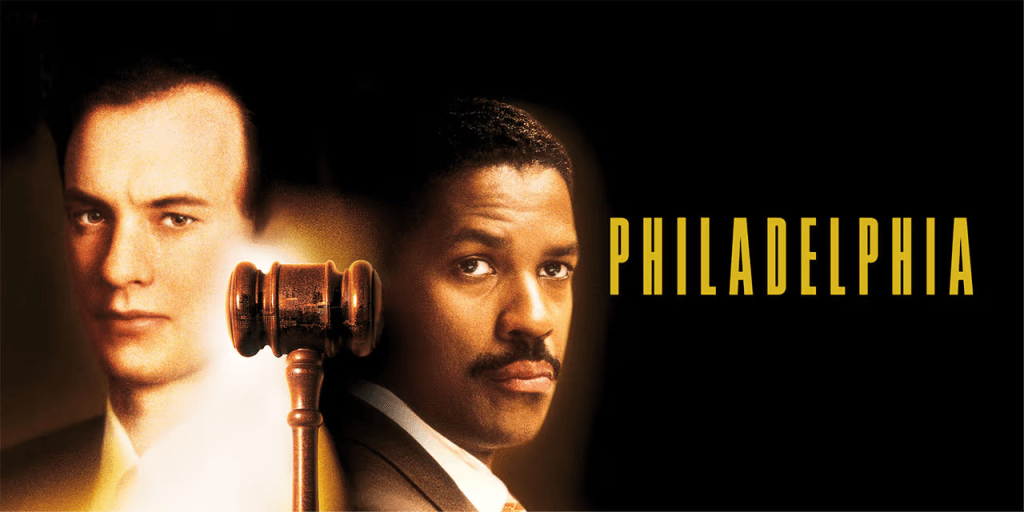
Director: Jonathan Demme
Starring: Tom Hanks, Denzel Washington and Jason Robards
‘A Captivating Classic’
Gay people are rarely depicted with respect in movies today. Hollywood has long held a history of building barriers against LGBTQ communities. Ever since the AIDS crisis of the 1980’s, the film industry has often mistreated queer communities. Despite homosexuality’s prevalence in the U.S., movies rarely shine moonlight on queer communities’ plight. Filmmakers have often struggled to depict a community facing barriers carrying the weight of the world on its shoulders. When making movies about LGBTQ communities, filmmakers fall prey to damaging stereotypes. Movies commonly portray queer people as helpless victims of adversities. For these reasons, it’s become rare to see realistic movies capturing the burden queer people bear.
In an industry where most movies often portray LGBTQ communities with stigma, “Philadelphia” stands out as an exception. Released in 1993, Jonathan Demme’s Oscar-winning movie did an extraordinary job of capturing hardships endured by the LGBTQ community. A groundbreaking piece of Cinema, “Philadelphia” was the first ever mainstream Hollywood movie to capture the AIDS crisis of a past era. It was one of the first films in Hollywood to portray gay people in a positive way. Boasting breathtaking production-design, engaging storytelling and phenomenal performances, it has stood the test of time as a captivating AIDS classic. At the centre of it all is a career-defining performance from Tom Hanks, who embodies a queer man diagnosed with AIDS facing despair. Ultimately, the film delivers a powerful message resonating with everyone facing workplace discrimination at an early age. A mesmerizing masterpiece, “Philadelphia” demands to be seen for depicting hardships queer communities in the AIDS era were facing.
Set in the 1980’s, “Philadelphia” tells the story of a queer man facing homophobia when he’s diagnosed with AIDS associated with stigma. Tom Hanks embodies Andrew Beckett, a queer associate working at a law firm in Philadelphia. Andrew has always gotten along well with employees in the firm that treat him respectfully. However, Andrew’s life forever changes when he’s diagnosed with a devastating disease putting his life in danger. After his employers learn he’s diagnosed with AIDS, Andrew is fired from his job immediately. Assisted by the lawyer Joe Miller (Denzel Washington), Andrew fights his firm in a courtroom case that’s conflicted. Facing a dilemma, Andrew questions whether he will survive a disease causing trauma.
Jonathan Demme is a newcomer to stories of LGBTQ communities. Before making “Philadelphia”, Demme had never made a movie about queer communities facing stigma. Demme was well-known for his Oscar-winning serial killer movie “The Silence of the Lambs”. It was the filmmaker’s first attempt to capture hardships faced by LGBTQ communities, but he succeeded. Through captivating cinematography, Demme captures a queer man facing homophobia during the 1980’s. Visually, the movie is a stunning feast for the eyes as breathtaking as courtroom cases Andrew seeks to organize. Demme effectively uses point-of-view shots to capture hardships that a queer man diagnosed with AIDS goes through. Whether it’s Andrew’s hallucination in the courtroom or his perspective of classical music, Demma effectively uses point-of-view shots capturing the perspective of a homosexual man with AIDS. Point-of-view shots elevate the courtroom scene where Andrew becomes panic-stricken being questioned by lawyers. Through this ingenious technique, Demme creates a strong queer character whom viewers can easily relate to. Point-of-view shots are tricky techniques to use in movies. However, this technique worked tremendously in the movie. Using breathtaking visuals, Demme captures hardships that LGBTQ communities in the 1980’s were facing.
Another admirable aspect of “Philadelphia” that’s worth discussing is the production-design. For a film made back in the 1990’s, the movie has aged incredibly over time. Demme’s decisions to shoot the legal proceedings scenes in a real-life courtroom is risky but works tremendously. Throughout the movie, Demme uses the claustrophobic setting of a courtroom to capture a queer man facing adversity. For instance, the courtroom setting elevates the interrogation scene. During this heartbreaking scene, Andrew faces nerve-wracking tension when he’s asked provocative questions by an intimidating lawyer that’s probing. One appreciates the courtroom setting capturing obstacles that queer men in the 1980’s were facing. Through the courtroom setting, Demme celebrates a community rarely treated in movies with value. Moreover, the musical score is another aspect of “Philadelphia” that I adore. Howard Shore’s soul-stirring music is key to the film’s success. Bruce Springsteen’s songs capture the atmosphere of an era characterized by homophobia. Through awe-inspiring production, Demme celebrates LGBTQ communities.
Storytelling is one of the main reasons why “Philadelphia” is a courtroom drama that’s so engaging. The film is beautifully written, and effectively uses flashbacks to create a compelling portrait of LGBTQ communities with AIDS. In Hollywood, most movies often portray gay people as victims that face a painful price to pay. Thankfully, though, “Philadelphia” avoids these pitfalls. Demme wisely avoids perpetuating stereotypes about LGBTQ communities. Instead, he effectively uses flashbacks to build a compelling portrait of a queer man with AIDS. Throughout the movie, Andrew recollects his past experiences leading up to his AIDS diagnosis. The film deftly switches back and forth between two timelines: Andrew’s present-day hardships with AIDS and joyous memories of his past before the diagnosis. Through this unique flashback structure, Demme creates a sympathetic portrait of a queer man with AIDS. Flashbacks are tricky techniques to use in movies. As Robert Zemeckis’ “Forrest Gump” suggested, flashbacks elevate historical dramas. Steven Spielberg’s “Catch Me if You Can” suggested flashbacks enhance con-artist movies. However, it works immensely. Through a spectacular screenplay, Demme celebrates gay communities today.
One admires astonishing performances. The film features stunning performances from two of the world’s greatest movie-stars today.

Tom Hanks delivers one of the best performances of his career as Andrew Beckett. Hanks achieved appreciation for playing adolescent boys seeking to be big. With “Philadelphia”, however, he took on his most demanding role. It isn’t easy to portray a gay man facing homophobia in Philadelphia, but Hanks succeeded. In an Oscar-winning role, Hanks poured his heart and soul into a queer man facing an emotional toll. With mesmerizing expressions, he captures angst, bravery and depression of a queer man facing workplace discrimination. It’s a phenomenal performance from one of the greatest movie-stars in Hollywood today.
Denzel Washington is dazzling as a dedicated lawyer devoted to his career that’s driven to defend a queer man treated in ways that aren’t fair. While Hanks gets the showier role, Washington is also excellent as a lawyer that’s skilled at keeping his emotions under control. As Joe Miller, Washington excels at portraying a persuasive lawyer through his commanding voice. Whether he’s loudly arguing with attorneys in courtrooms or silently consoling Andrew after his breakdown, Washington effectively uses his voice to create a lawyer that’s compelling. It’s a powerful performance from one of the greatest African-American actors today.
Finally, “Philadelphia” is a film everyone would appreciate for depictions of homophobia in a past era. Unlike most movies about the LGBTQ community, it’s one of those rare films everyone would relate to. It discusses universal themes including identity, mental health and sexual identity. Viewers aren’t required to be members of the LGBTQ community to appreciate the movie. Despite taking place in a past era, the film’s themes remain relevant today. It delivers a universal message concerning workplace discrimination with which everyone would engage. Therefore, “Philadelphia” is one of those rare films everyone would adore.
Members of the LGBTQ community will definitely appreciate “Philadelphia” and so will movie-goers seeking meaningful entertainment. A captivating classic, it celebrates a community that faced barriers in America which were catastrophic.
Nearly 30 years following the release of an iconic film that blew audiences away by depicting gay men in Philadelphia diagnosed with AIDS facing a painful price to pay, it’s a phenomenal tribute towards LGBTQ communities that have experienced hardships throughout the course of American history rarely treated in a fair way that could shine a bright ray of light into the dark lives of queer individuals whose inspiring stories of overcoming hardship definitely without a doubt deserve to be depicted with respect in movies today.
5/5 stars

 The Film Buff
You must be logged in to post a comment.