
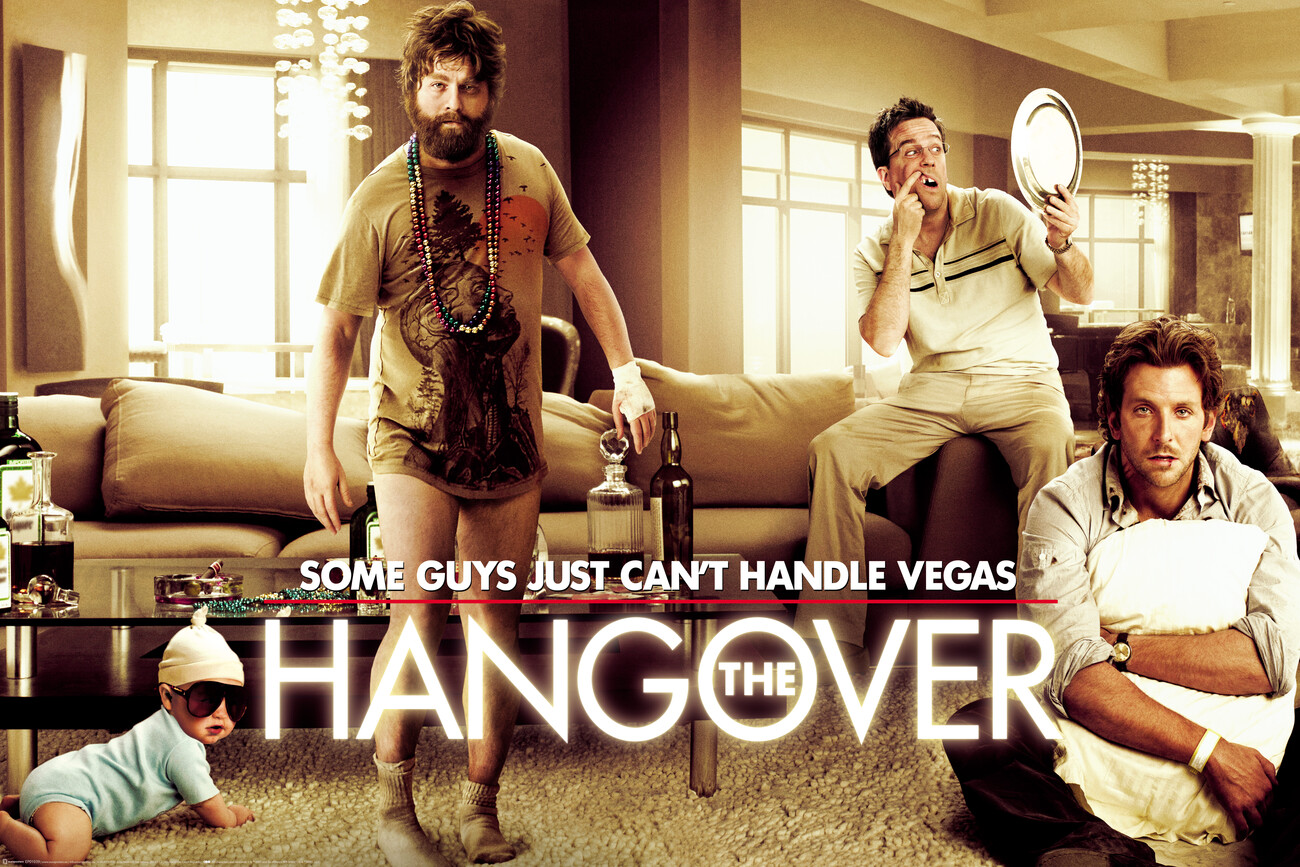
Director: Todd Phillips
Starring: Bradley Cooper, Zach Galifianakis and Heather Graham
‘A Captivating Comedy’
Alcohol addiction is a sensitive subject which is rarely ever depicted in movies with respect. Hollywood has often struggled to tell stories of alcohol addiction that are true to reality. When portraying the lives of alcohol addicts on the big-screen, directors often fall prey to stereotypes. Movies always have the tendency to glamorize alcohol addiction as a positive activity without any real consequences. Films often portray the joy of alcohol without the consequences it can cause coming with a painful price to pay today. Focusing on the positive effects of substance abuse, movies seldom capture the way alcohol addiction leads to serious issues. For these reasons, it’s rare to see realistic depictions of alcohol addiction in commemorated movies.
In an industry that has always glamorized alcohol addiction, “The Hangover” is a film that stands out as being an exception. Released in 2009, Todd Phillips’ comedy did an extraordinary job of capturing the painful realities of substance abuse. Boasting stunning production, sharp storytelling and powerful performances, it’s a captivating comedy about alcohol addiction. At the centre of it all is a phenomenal performance from Bradley Cooper, who embodies an alcohol addict facing an endless hangover. Although “The Hangover” is a captivating comedy, it isn’t a flawless film. It builds to a conventional conclusion that glamorizes alcohol addiction. Nevertheless, it offers hilarious entertainment that fans of Bradley Cooper won’t be able to resist.
“The Hangover” tells the story about a pair of friends that embark on an adventure to Las Vegas to enjoy a hangover. Bradley Cooper embodies Phil, a charismatic teacher with addiction to alcohol. Phil’s dreams come true when he’s given a chance to spend time with his friends on a trip to Las Vegas. Assisted by his close friends Doug and Alan, Phil embarks on a trip to the city seeking an escape from reality. However, what seems to be an exciting trip soon becomes a nightmare when Phil discovers the dangers of alcohol addiction. Waking up disoriented in a state of a hangover, Phil questions whether he can recover from alcohol addiction. Facing a dilemma, Phil and his friends become lost in the state of hangovers in one of the most luxurious cities in America.
Todd Phillips has always been drawn towards comedies. Before he directed “The Hangover”, Phillips was known for his comedies about college friends. With “The Hangover”, however, the directed created his first comedy on drug addiction. It was the filmmaker’s first attempt to capture the danger posed by alcohol addiction causing people to face disasters, but he pulled it off deftly. Through gorgeous cinematography, Phillips captures a pair of friends embarking on a drug-fuelled journey. Phillips effectively uses montages to capture the bonds between a pair of friends that love drinking. For instance, montages elevate the road trip scene. During this unforgettable scene, Phil and his friends embark on a road trip to Las Vegas in their car. One admires montages capturing the bonds between a pair of addicts. Montages are tricky. However, they work tremendously in this movie. Through stunning visuals, Phillips captures the bonds between friends that engage in heavy drinking.
Another admirable aspect of “The Hangover” which deserves appreciation is the production. Phillips effectively uses the production-design of apartments to capture individuals enduring a hangover. For instance, the production-design of the apartment elevates the hangover sequence. During this unforgettable scene, Phil and his friends wake up in a disoriented state in their apartment after a hangover. One appreciates the production-design of apartments capturing the grim realities of alcohol addiction. Through this ingenious set-design, Phillips captures the harsh realities of alcohol addiction causing lives of individuals to decline. Moreover, the musical score is magnificent. Christophe Beck’s music captures the painful consequences of alcohol addiction which is tragic. Through stunning production-design, Phillips capture the harsh realities of alcohol leading the lives of individuals to decline.
Storytelling is one of the main reasons why “The Hangover” is a comedy that’s captivating. The film is beautifully written, and effectively uses humour to capture the harsh realities posed by alcohol addiction. Phillips’ greatest strength as screenwriter is capturing the tough subject matter of alcoholism with a sense of humour. Most films portray alcohol addiction as a positive activity without any price to pay. Thankfully, however, “The Hangover” avoids these pitfalls. Phillips captures the painful realities of alcoholism by humour. It isn’t simply to infuse humour into a subject as serious as alcoholism, but it works tremendously. At times, the film is hilarious in scenes where the friends crack jokes about their absurd situation. However, at the same time, the movie is also serious in depicting the harsh realities of substance abuse. Using this clever humour, Phillips creates characters with alcohol addiction that viewers can easily relate to. Humour is a tricky technique to use in movies about alcohol addiction. It’s a serious condition posing dangers that’s no laughing matter. Nevertheless, it works tremendously in this movie. Through a commemorated screenplay, Phillips captures the harsh realities of alcohol addiction affecting individuals today.
One admires astonishing performances.
:max_bytes(150000):strip_icc():focal(731x139:733x141):format(webp)/bradley-cooper-the-hangover-112423-a25250779ef24b7e9b30ebeb18c25eef.jpg)
Bradley Cooper delivers one of his best career performances as Phil. Cooper earned praise by playing men crashing weddings in raunchy comedies. With “The Hangover”, however, he took on his first alcohol addict role. It isn’t easy to embody the personality of a man experiencing the states of hangovers, but he succeeds tremendously. Through mesmerizing expressions, he conveys angst, sharp sense of humour and reckless behaviour of a man struggling to recover from a hangover. Drawing from his own personal experience as an alcohol addict, Cooper creates a realistic portrait of a man suffering from severe alcohol addiction. It’s an extraordinary performance from one of the greatest actors working in the industry today.
The supporting cast is spectacular and worthy of appreciation. Zack Galifianakis is fantastic, capturing the comical personality of a man engaging in drug abuse causing consequences that are tragic. Ed Helms is excellent, bringing a sense of gravitas to the movie as a fed up husband realizing hangovers are definitely not worth the consequences. Lastly, Ken Jeong merits appreciation. As Mr. Chow, he brings hilarious comical relief to the movie.
Despite its fantastic performances, however, “The Hangover” can’t quite capture the dangers faced by individuals having a hangover. If there’s a minor shortcoming to the movie, it lacks a compelling ending. It’s a formulaic conclusion without a satisfying resolution. It fails to bring the movie towards a satisfying resolution. At worst, it perpetuates the harmful message individuals can easily get away with engaging in alcohol addiction without enduring damage. Whereas this lighthearted ending elevated Martin Scorsese’s “The Wolf of Wall Street”, it clashes with this movie. Comedies thrive based on their satisfying endings, and in this regard the film falls short of expectations. Therefore, “The Hangover” can’t quite capture the emotions of individuals facing a hangover.
Nevertheless, fans of comedies will definitely appreciate “The Hangover” and so will movie-goers seeking hilarious entertainment. A captivating comedy, it captures the dangers posed by hangovers that have a negative impact on individuals’ well-being.
A hilarious depiction of horrific hangovers causing outrageous consequences in the lives of men that face circumstances which are dangerous, it’s a powerful reminder about the power of Cinema as a therapeutic art-form that can be used to address substance abuse in society by telling courageous stories spreading awareness about a deadly all-too-often ignored condition that turns lives of individuals upside down proving movies can be a precious form of art that have the abilities to educate the public about a real-life addiction that is dangerous.
4.5/5 stars

 The Film Buff