

Writer/Director: Robert Benton
Starring: Dustin Hoffman, Meryl Streep and Justin Henry
‘A Timeless Classic’
Divorce is a devastating process causing families to face stress. It’s easier said than done to deal with the damage caused by the end of a marriage. A process that comes with a heavy emotional toll, divorce often leads the lives of happily married couples to spiral out of control. Whether it’s the conflicted arguments between spouses or lives of children that are emotionally affected, divorce entails consequences leaving families deteriorated. Given the sensitive nature of the topic, divorce is rarely depicted in movies in ways that are realistic. It’s challenging for the art of Cinema to capture a painful process that tears families apart. For these reasons, it’s rare to come across authentic movies that capture marriages enduring tragedies.
Few films that I have ever seen have managed to capture the divorce process in a manner as realistic as “Kramer V. Kramer”. Released in 1979, Robert Benton’s Oscar-winning movie did an extraordinary job of capturing how divorce leads lives of stable families to decline. For a film made in the 1970’s, “Kramer V. Kramer” has aged incredibly well. It’s a groundbreaking film that was the first ever mainstream Hollywood movie to capture a process that at the time was misunderstood. Boasting exquisite production-design, sharp storytelling and phenomenal performances, it’s arguably the greatest movie ever made about divorce. At the centre of it all are a pair of phenomenal performances from Dustin Hoffman and Meryl Streep, capturing the emotional impact caused by divorce on spouses. Ultimately, the film delivers a meaningful message that will resonate with everyone that has witnessed a broken marriage at an early age.
Set in 1970’s New York, “Kramer V. Kramer” tells the story of a frustrated couple experiencing devastating divorce whose marriage is in danger. Dustin Hoffman embodies Ted Kramer, a career-oriented advertising executive struggling to manage a broken marriage. Kramer often spends long hours working leaving him little time for his wife Joanna (Meryl Streep) and son Henry. Kramer’s life spirals out of control when his wife files for a divorce causing an emotional toll. As the couple go head to head fighting in court over child custody, they discover the painful realities of a process that is never intended to end happily.
Robert Benton is a newcomer to stories of divorce. Prior to directing “Kramer V. Kramer”, Benton was best known for making old-fashioned murder mystery movies. It was the filmmaker’s first attempt capturing the devastating divorce process on the big-screen, but he succeeded tremendously. Through captivating cinematography, Benton captures a family struggling to cope with a devastating divorce tragedy. Visually, the film is a feast for the eyes capturing how divorce breaks family ties. Benton effectively uses close-up shots to emphasize emotional turmoil faced by a couple experiencing divorce. Whether it’s Joanna’s tearful face when she is separated from her child or Kramer’s reaction of shock to divorce, the close-ups effectively convey the emotional toll of divorce. For instance, close-ups elevate the scene where Joanna informs Kramer that she is leaving him to file for divorce. Benton effectively uses close-ups on the actors’ faces to communicate the consequences of a process leading lives of couples to deteriorate. Through captivating cinematography, Benton captures the negative impact that divorces have on families.
Another admirable aspect of “Kramer V. Kramer” that contributes to its success is the production. For a film made in the 1970’s, the movie is beautifully made with impressive production. For instance, Benton effectively uses confined spaces of apartments to capture the strong bonds divorced fathers share with children. Throughout the movie, Kramer is tasked with taking care of his son in a confined apartment. The apartment becomes a clever location showcasing bonds between divorced parents and children. Confined spaces are tricky techniques to use in movies. As Alfred Hitchcock’s “Rear Window” suggested, confined spaces elevates classic Hitchcock mysteries. Nevertheless, it succeeds. Through confined spaces, Benton captures bonds children develop with parents facing divorce. Using stunning production, Benton captures impact of divorce on children.
Storytelling is one of the key reasons why “Kramer V. Kramer” is such an effective film. The film is beautifully written, and uses sequences of silence to capture impact of divorce on couples’ well-being. In Hollywood, most movies about divorce rarely address the consequences of a process that causes stress. Most movies about divorce have happy endings where couples move on from broken marriages without adversities. Thankfully, though, “Kramer V. Kramer” avoids these pitfalls. Benton expertly uses sequences of silence to capture the negative impact of divorce on the lives of children. Silence elevates the scenes where Henry becomes silent refusing to talk after witnessing his parents experiencing an intense argument. Minimal dialogue is a tricky technique to employ in movies about divorce. Most movies about marriages facing devastating divorce tragedies are driven by dialogue and rely on conversations to keep viewers engaged. However, it works tremendously in “Kramer V. Kramer”. Through a spectacular screenplay, Benton captures the painful consequences of a process that comes with an excruciating price to pay.
One admires astonishing performances. “Kramer V. Kramer” wouldn’t be an iconic classic if it weren’t for the phenomenal performances from two incredible actors.
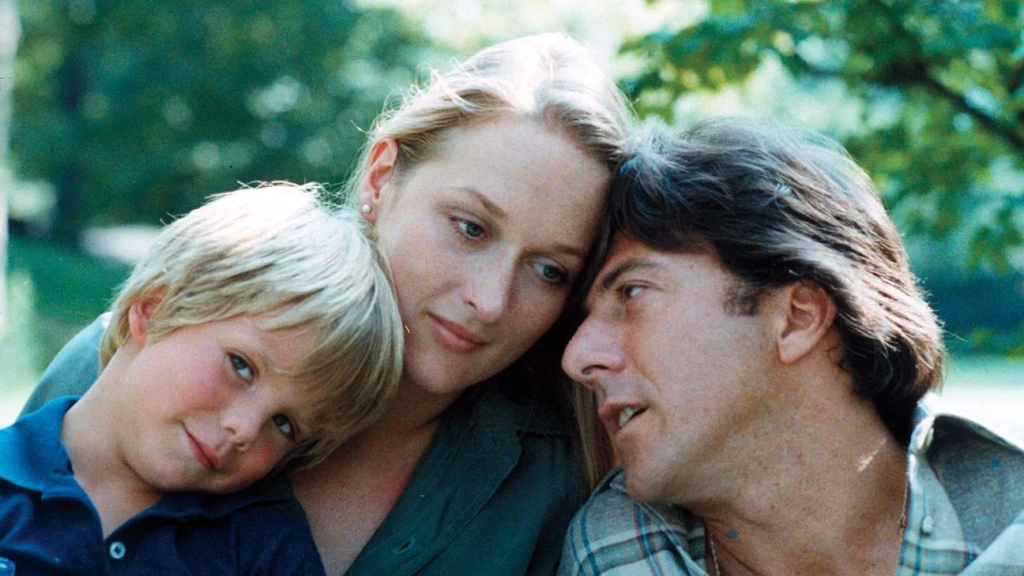
Dustin Hoffman delivers one of his best career performances as Ted Kramer. Hoffman achieved appreciation for playing dedicated journalists investigating shocking scandals. With “Kramer V. Kramer”, however, he took on his most dramatic role. It isn’t easy to embody the personality of a father facing a divorce tragedy, but Hoffman succeeds tremendously. With mesmerizing expressions, he captures the angst, frustrations and remorse of a compassionate father struggling to cope with a devastating divorce. It’s a phenomenal performance that launched the career of one of the most beloved movie-stars in Hollywood today.
Meryl Streep is magnificent as a vulnerable woman unable to handle a divorce with separations from children that are painful. While she gets less screen-time compared to Hoffman, Streep is equally extraordinary. In the role for which she won a well-deserved Oscar, Streep captures the broken soul of a divorced woman experiencing a toll. Whether she’s tearfully separating from her child she loves dearly or angrily glaring at her husband in courtrooms, Streep captures impact of divorce on women through expressions. It’s a powerful performance demonstrating why Streep remains one of the greatest actresses in Hollywood today.
The last standout in the cast is Justin Henry. As Henry, he beautifully captures the conflicted emotions of children facing divorce tragedies.
Finally, “Kramer V. Kramer” is one of those rare movies everyone would appreciate for its realistic marriage story. Evoking Noah Baumbach’s “Marriage Story”, the movie captures couples that face divorce tragedy. It tackles universal themes including parenting, child custody and work-life balance that would resonate with everyone. Despite being made during the 1970’s, the film remains more relevant than ever in the modern century. It delivers a universal message which would engage everyone that has witnessed a broken marriage at an early age. Therefore, “Kramer V. Kramer” is one of those rare movies about divorce everyone would adore.
Fans of divorce dramas will definitely appreciate “Kramer V. Kramer” and so will movie-goers seeking exhilarating entertainment.
Nearly 40 years following the release of an iconic film about frustrated couples experiencing divorces which are catastrophic, it’s a rousing reminder about the power of Cinema as a therapeutic art-form that can inspire modern-day couples enduring the terrifying barriers of marriage tragedies to move on several years after ending marriages in ways proving catastrophic.
5/5 stars

 The Film Buff
You must be logged in to post a comment.