
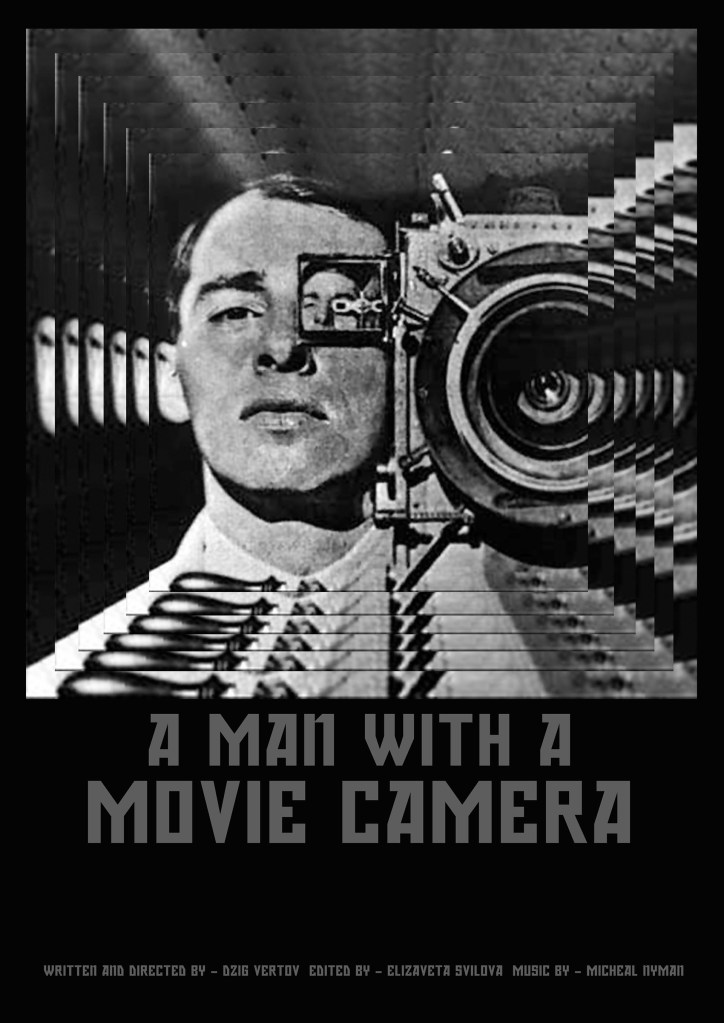
Writer/Director: Dziga Vertov
Starring; Dziga Vertov
‘A Magnificent Masterpiece’
When it comes to the history of Cinema, there are few films in the world that are as influential as Dziga Vertov’s “Man with a Movie Camera”. Ever since it was first released in 1929, this black-and-white silent film forever changed the way that motion-pictures were looked upon by the general public. By incorporating innovative effects, fast-paced editing and a haunting musical score, Dziga Vertov’s film represented a leap forward for the art of filmmaking. And though it was released more than 80 years ago, this ground-breaking motion-picture continues to be celebrated by movie-goers to this day.
Today, however, a new generation of movie-goers wonders why this motion-picture left such a lasting impact on the film industry of Hollywood. According to media theorist, Lev Manovich, the legacy of “Man with a Movie Camera” goes beyond pure cinematic entertainment. In his famous book The Language of New Media, Manovich argues that the 1929 silent film was not only a cinematic achievement but also integral to the history of media. In other words, not only did it push the boundaries of filmmaking but it also played a role in the formation of new media. In his view, “Man with a Movie Camera is perhaps the most important example of database imagination in modern media art” (Manovich 209). Manovich explains that “Man with a Movie Camera” is not just a film, per say, but particularly relevant to new media. How so? Most importantly, the experimental film showed viewers the full range of possibilities offered by a camera. “Man with a Movie Camera” was one of the first films ever in history of Cinema to introduce viewers to the possibilities of the camera and what it could accomplish. This helps to explain why “Man with a Movie Camera” was an influential motion-picture and why it continues to be admired by film buffs and critics till this day.

Another reason why the silent, black-and-white film hasn’t aged is because it incorporated editing techniques that are used in movies to this day. Whether it is fades, dissolves or superimpositions, “Man with a Movie Camera” is put together using a wide range of editing techniques that are still used in films today. As a result, “Man with a Movie Camera” has a timeless quality that makes it accessible for both older and modern movie-goers alike. For example, while watching the film, I was struck by how modern it was. In fact, it is almost hard to believe that it was released nearly 90 years ago.

In addition to its ground-breaking effects, “Man with a Movie Camera” has also stood the test of time because of its entertainment-value. Despite the fact that there is no dialogue or characters in the film to root for, it is still able to leave a lasting impression on viewers. This is due to an engaging narrative that unfolds at a fast pace. Set in the Soviet Union, the film follows a day in the life of a city from morning to night. The film takes place in numerous locations, from a theater hall to the busy streets of the city. At a first glance, one may think that this would make for a rather monotonous film. And yet, “Man with a Movie Camera” is anything but monotonous. On the contrary, it is the exact opposite. Through an unforgettable orchestral score, eye-catching imagery and sharp editing, Dziga Vertov managed to create a film that was thoroughly entertaining from start to finish.
On a final note, it is hard to watch “Man with a Movie Camera” today without noticing the attention that is given to detail. From a filmmaking point-of-view, each shot is meticulously framed and draws the attention of the viewer. One of the most interesting aspects about the way the film is shot is that the camera almost functions as an observer. Whether it is capturing a chaotic day on the streets of a city or ordinary people on their way to work, the camera observes the events taking place. When he made the film, Dziga Vertov believed that the camera was an extension of the human eye and could capture events that were beyond the limits of human vision. In other words, the camera could capture events that the ordinary human eye could not.

Ultimately, his beliefs set the stage for a timeless film that marked a turning point in the history of Cinema. By introducing the world to the possibilities of the camera, a wide range of editing techniques and as Lev Manovich proposed, the language of new media, “Man with a Movie Camera” left a lasting impact on the evolution of films. Although it was made nearly 90 years ago, Dziga Vertov’s film continues to inspire individuals to pick up a camera and explore the possibilities of movie-making today.
5/5 stars

 The Film Buff
You must be logged in to post a comment.